Showing posts with label The Ionia Sanction. Show all posts

Audio edition of The Ionia Sanction on sale at Downpour

Downpour is the online consumer division of Blackstone Audio, who sell audio books to libraries.

Right now Downpour is selling the audio edition of The Ionia Sanction on their special deals page.

And in passing, I'm in good company in that sale.  I never thought I’d see the day when my name was on the same page as Isaac Asimov, Conan Doyle and Patrick O’Brian. 


Proxenos: a job both ancient and modern

It's not every day you get email from a US Consul.  But such was the case a week ago when I received a lovely email from Mr Mark Mohr.  Mr Mohr's a retired US diplomat and a mystery reader.  And very glad I am that he emailed, because he mentioned something interesting to do with The Ionia Sanction.

In The Ionia Sanction there's a character named Thorion.  Thorion has a special job: he's a proxenos.

Proxenos was one of the most interesting official jobs a man could have in Classical Greece.  The pro means for, the xenos means foreigner.  Hence proxenos means someone who acted on behalf of foreigners.

The system worked like this:  cities didn't have a diplomatic service back then, so what they did was find men among the other cities who were well-disposed toward them, and then ask those foreign men to act on their behalf.

Thorion is a citizen of Athens, and always has been.  But he married a woman from Ephesus and he has intricate trade connections to Ephesus.  Thorion therefore acts as the proxenos for Ephesus in Athens.  He officially represents them.

If someone from Ephesus is in Athens and in trouble, he can go to Thorion for help.  If a merchant in Ephesus wants to trade in Athens, he could ask Thorion for advice and introductions to Athenian traders.  If Athens was considering passing some trade law that would disadvantage Ephesus, then Thorion -- even though he was a citizen of Athens -- might reasonably stand up to argue against it, and his fellow citizens would expect him to do just that.

The proxenoi appear to have been at least as effective as the consulates of modern times.  With the hundreds of Greek city-states, and their intricate political and trade alliances, the proxenoi must have formed a complex and fascinating network of men.

I thought the proxenoi were no more, replaced by modern consuls.  But to my delight, I was wrong.  Mark mentioned:
"Actually, there is such a system in modern diplomacy; they are known as honorary consuls. For example, when I was [US Consul] in Brisbane, a prominent Greek-Australian attorney was the honorary consul for Greece. At the time I was in Brisbane, only eight consuls were citizens of the sending country, whereas more than twenty honorary consuls, all Australian citizens, represented foreign interests. So apparently the Greek gift of the proxenoi system continues into present times."
Not only do the proxenoi still exist, but they're in my own country.  And one of them is proxenos for Greece!


Working titles

I guess this might interest a few of the writer-types among us.  When you sell a book, the title on the front of your ms isn't necessarily the title that will appear when it pops out as a real printed book.  That's why they call them working titles.

The original working title for The Pericles Commission was The Ephialtes Affair.  At the time, you see, I was thinking in terms of an Agatha Christie title scheme.  The Mysterious Affair At Styles... The Ephialtes Affair.

Then I sold the book.  Or rather, my brilliant agent sold the book.

After the editors had finished recoiling in horror, it was clear the title would have to change.  To start with, Ephialtes is an incredibly awkward name for a title.  Secondly, affair has another meaning.  Was this book about a love affair with a Greek shipping magnate?

This is the point where an author needs to be more in love with the idea of a successful book, than in love with his own words.  Luckily for me, I'm entirely devoid of sentimentality.  The only problem was to come up with a new naming scheme.

It was me who came up with The Pericles Commission, but it could have been any one of the five of us who were thinking about a new title.  Consensus came when we realized this wasn't a Christie-like series; it was more like Robert Ludlum.   So I moved from an Agatha Christie naming scheme to a Robert Ludlum naming scheme.

Having learned the lesson with book 1, you'd think I'd get the title for book 2 right, wouldn't you?  I did, sort of.  The working title was The Magnesia Sanction.

All was well until the editor pointed out that in America, the only use of the word magnesia was in milk of magnesia, which is used to treat bowel complaints.  Perhaps that was an association we would wish to avoid.  

The Magnesia Sanction became The Ionia Sanction.   The city of Magnesia was in the province of Ionia, so it was an easy fix.  If anything it sounds better.

Which brings us to Sacred Games.  It's the first time my working title has survived!


Reading Order

I had an email from a wonderful reader named Sandra, who very sensibly asked what's the right order to read the books of the series?

That was when I realized that silly Gary has never written it down, so here for the record is the book sequence:

The Pericles Commission

The Ionia Sanction

Sacred Games


The next book in line has working title The Marathon Conspiracy.  Working titles don't always stick, so stay tuned on that.

Each book is written to stand on its own, so technically it doesn't really matter in what order you pick them up.  I know for sure some readers have come to the series starting with book 2 or 3, and then gone to Pericles Commission.

Of course if a character appears in a later book, then you know they survived any earlier books!  Beyond that unavoidable information, I'm careful to omit spoilers on who did it from earlier adventures.


A review of The Ionia Sanction from Alun Salt

Alun Salt's written a review of The Ionia Sanction, which you will find here at his web site.

By trade Alun is an archaeoastronomer, which is about as rare a profession as you're likely to come across, and fascinating if you happen to be into both astronomy and ancient history.


New edition of The Pericles Commission comes to the US

The Pericles Commission is being released by Soho Press in the US in trade paperback.  That's the large size mass market format.  And to my surprise, they're using the Australian cover!


Pericles Commission releases in paperback in the US in only two days' time, on January 15 2013.  Then on 19th March they're releasing a paperback edition of The Ionia Sanction:


The coin used on the cover of this edition of Pericles Commission has a very interesting history, which I previously wrote about in this post.


Trivia quiz: I scored 10/10 for my own book!

I am relieved to announce that I have scored 10 out of 10 in a trivia quiz about my own book.  Asmah on Goodreads has put up a trivia quiz for The Ionia Sanction.

Here's the quiz if you want to give it a go:   Ionia Sanction Trivia Quiz


The Ionia Sanction at the Historical Novel Society

The Historical Novel Society reviewed The Ionia Sanction months ago, and I utterly failed to report it here.  I'm correcting that grievous fault now.  Here's what they had to say:
Athens, 5th century B.C.: Nicolaos is an investigator for hire, which is not so strange considering this is the city that invented the professional philosopher. Fresh off his last case in The Pericles Commission, Nico (if I may be familiar) has another politically charged murder to solve. This time the investigation takes him to Ephesus, where he uncovers a Persian plot to conquer Athens. 
The action is solidly paced and engaging throughout, while Nico’s noir-ish patter makes the history highly accessible. And there is a lot of history; every major figure gets a mention, including an irritating little brat named Socrates who happens to be Nico’s kid brother. 
Corby weaves in most of these historical nuggets skillfully, and a few that at first appear to be one-off mentions end up being quite relevant to the plot. There are also some very amusing, if slightly anachronistic, jabs at modern times when Nico struggles with concepts such as trousers (a Persian innovation), and mercantilism (“You mean I could come here with a bit of money…buy something I didn’t make myself… and I’d make a profit?”) But Corby succeeds best when he shows us the subtle little nuances of the era. Moments such as Nico’s impromptu – and very touching – sacrifice to Artemis show us that he’s a lot more than Sam Spade in a chitoniskos. He’s a man of a different and very intriguing era, and he’s worth reading.

Such a strange concept

This review of The Ionia Sanction just appeared in the Sunday Herald Sun, an excellent Melbourne newspaper

SUCH a strange concept — a murder mystery set in ancient Athens — yet it works so well in history buff Gary Corby's second Hellenic mystery, The Ionia Sanction. 
The year is 460BC and Nicolaos, the only investigating agent in Athens, is called on by the city's leader, Pericles, to investigate the suspicious death of an Athenian official. 

But after tracking the killer and letting him slip through his fingers, Nico finds himself on his boss's bad side and desperate to make amends. 

Nico's quest to solve Thorion's murder takes him across the oceans to the Persian Empire. There he runs into his ex-girlfriend, meets the infamous Greek traitor Themistocles and uncovers a Persian plot that threatens to destroy Athens. 

This fascinating book blends historical events and figures with fiction to create a funny, gripping and satisfying mystery you won't be able to put down. 

SAMANTHA LANDY 
VERDICT  ★★★★☆ 

It occurs to me people might not know how newspaper reviews come to be.  The simple answer is: I don't have much of a clue myself.  

What happens is Heidi the Publicist, who's extremely good at this sort of thing, sends  the book out to known quality reviewers and then waits to see who's interested.  The first I hear of a review is when Heidi or some other responsible adult lets me know it's out there.  My contribution is absolutely zero, if you don't count writing the book in the first place.  I have no idea what any review is going to say until it appears.  

Reading your own reviews is a slightly nervous process; I read the first paragraph, then I read the last paragraph to see if I'm doomed.  Then with a feeling of relief I read the whole thing; at least three times.

I'm an obvious classical Greek tragic

Apparently I'm an an obvious classical Greek tragic, which I thought was a very funny way of putting it.  I've a feeling my wife will be quoting that for some time to come.  The quote's from a review of The Ionia Sanction, that appeared in The Telegraph in Sydney on the weekend.  The page scan kept on coming out blurry, so here's the text:

WHO reckons ancient history is boring?  Certainly not Australian author Gary Corby, who weaves a gripping whodunit set in classical Greece, 2500 years ago.  

The second of his Hellenic Mystery series, The Ionia Sanction follows on from the first, The Pericles Commission, with clever young Athenian Nicolaos given the job of uncovering a murderer. 

With his tongue set firmly in his cheek, Corby combines real-life and fictional characters in this fun romp, which journeys from Athens to Ionia in the Persian Empire. 

When an Athenian official is murdered, rising statesman Pericles reluctantly gives Nico the job of finding the killer. Nico — who only has a couple of years to prove to his father that he can succeed in his chosen profession before going back to the family's sculpture business — is pragmatic and has no time for philosophers. That's a problem — he has a philosophical 12-year-old brother called Socrates.  

The trail leads from Athens to Ephesus in the Persian Empire, where he finds his girlfriend, the priestess Diotima, an amateur detective whose case is linked to Nico's.  With polite but murderous brigands chasing him and a haughty slave girl, Nico finds himself in the court of the military genius Themistocles, who was once the hero of Athens but now lives in exile and in the pay of Persians.  

While Corby is an obvious classical Greek tragic, he also has a sense of fun and The Ionia Sanction is a real page-turner.  

Chris Herde

Buy 1, get the other free

Borders Australia is doing a promotion.  If you buy The Ionia Sanction, they'll send you The Pericles Commission to go with it.  Here's the promo, from their latest mailout:


I've linked the image to their promo page, if anyone's interested (you then have to click on the tab that says "A Hellenic Mystery").  By my rough calculation, that deal comes to 1/100 th of a cent per word.  I'll be a millionaire in no time.

I found out about this when my sister forwarded the email to me!  Something that non-writers normal people don't necessarily realize is the degree to which the author loses sight of a book once it reaches the stores.  It's a bit like not knowing if the light goes out when you shut the fridge door.  Things like this are a lovely reminder that there really is a machine in place getting books to people!

The Ionia Sanction releases in Australia

It's the start of a new year. Happy 2012 to everyone!

 That also means The Ionia Sanction has finally released in my native homeland. Yay!

It's quite bizarre to poke your nose inside a store and see your own work on the shelves. Also fun.  I'm afraid it's reached the point where my children automatically say, "Don't look, daddy!" every time we approach any store that displays books. Oh well. So much for impressing the kids.

I want to say a huge, vast, enormous thank you to Belinda Byrne, who in addition to being a really nice person, took a chance on the crazy idea of a detective series in ancient Athens. If it weren't for her, there wouldn't be that lovely cover with the blue background and the lion's head coin that you see on the right. 

Thanks too to my wife Helen, an entirely apposite name under the circumstances, and to our daughters. The dedication on The Ionia Sanction says this:

For Helen, Catriona and Megan

Two reviews from interesting sources

Two new reader reviews:

Review number 1 is for The Pericles Commission.

What makes this interesting is that it's reviewed by Alun Salt, who's a for-real archaeoastronomer, which has to be one of the cooler job titles around.  Alun helped me out with some dates for the third book, because the ancient Olympics was scheduled to run according to various phases of the moon around the summer solstice.  So he was able to give me information on how much light there would have been to see by at the time of the murder.

Alun's done some very interesting research on the placement of Greek Temples relative to the sun, which I blogged about some time ago.

So Alun looked at my first book very much from the viewpoint of someone who knows the period in minute detail as a professional.  Here's his review.

He raises quite a few points that I haven't seen elsewhere.  I won't clutter this post with detailed talk about them.  Only insane authors argue with reviews, and in any case there's nothing to argue with, but I'll definitely be back to discuss some of the things he mentions in a later post.


Review number 2 is for The Ionia Sanction.  But not the book; it's for the audio version.

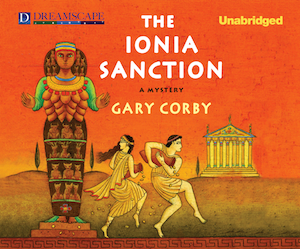
Dreamscape is an audio book producer in the US.  They hired an American actor to read the book end to end.  I hope he liked it, because he had to read every word very clearly!

The audio version of The Ionia Sanction is now for sale, and thanks very much to Dreamscape for doing it.

The audio review was written by Bernadette at Fair Dinkum Crime, who very clearly is not American, and I was interested to see how that affected the listening.


Swapna Krishna reviews The Ionia Sanction

This just popped up, a lovely review of The Ionia Sanction from Swapna Krishna!

If you go read it, stay to check out her other reviews.  I don't know how many books Swapna's read, but it's a lot, and her review style is impressive.


An odd job for central casting

Marshal Zeringue runs three rather interesting book blogs. He kindly asked me to contribute to all three last year, and he repeated the favour this year.

Here's the first: My Book, The Movie.  The premise being, if I was to make a movie of The Ionia Sanction, how would I cast it?   I didn't nominate all the characters -- there are too many to think about! -- but I did hit a few of the majors.

A change is as good as a holiday

I've given the blog its first makeover in more than a year, in honour of The Ionia Sanction releasing tomorrow.  (Tomorrow!  OMG!)

If you'd been watching, you'd have seen the background texture, colour, intensity, and brightness, and the header text and the picture of Nico and Diotima change about every 30 seconds for the last four hours as I struggled to get everything bedded in.  Sorry about that.

I think we're more or less stable now, but do please let me know if anything isn't working for you.

Next up, Ionia Sanction gets its very own page tab, and I remember when it was only a few lines of text on my PC.  How the time flies.


Two more reader reviews, and an interview

Sarah W has posted a review of The Ionia Sanction on her blog, complete with footnotes.  Hop on over to Earful of Cider to see what she thinks!  Also to discuss the mysteries of ancient Greek underwear.

Meanwhile, L.T. Host has written her own review, which includes a little interview with me on the subject of my favourite deaths, and ancient versions of Halloween.

Thank you, ladies!

Kirkus on The Ionia Sanction

Kirkus is a major and much respected literary review magazine.  They've just had this to say about The Ionia Sanction.  Their judgement is in the final paragraph.
An inexperienced sleuth learns that the deeper the mystery, the higher the stakes.

Pericles, the leader of Athens, calls his young protégé Nicolaos to investigate the death of Thorion, a proxenos—that is, a sort of lobbyist for a city—from Ephesus, in Ionia, across the Aegean Sea from Athens.

An apparent suicide, Thorion was found hanged, and there's a note to Pericles in which he confesses betraying his office.  It would seem to be an open-and-shut case, except that Nicolaos notices some odd details that indicate the scene was staged.

Further confirmation comes when Nicolaos is attacked and barely escapes with his life. Characteristically, Pericles ignores his injuries and asks why Nicolaos didn't catch his attacker.  And he orders him to find the killer.  Thorion's son Onteles gets the investigation rolling when he visits Nicolaos, implicating a slave named Asia, whom Nicolaos literally rescues from the auction block.  Far from being a girl of the streets, let alone the lynchpin of a murder mystery, Asia maintains that she's the daughter of Themistocles, the Satrap of Ephesus' neighboring city, Magnesia.  But is she?  Nicolaos does what any young sleuth in distress would do: He consults his parents.

A journey to Magnesia uncovers a far more pernicious plot than a single killing, with literary conundrums figuring in the solution.

Nicolaos' sophomore mystery (The Pericles Commission, 2010) is abundantly appointed with maps, historical notes, a list of characters with pronunciation assistance and bromides to open each chapter. With action scenes, a colorful setting and narrow escapes, it reads less like a whodunit than an adventure story, albeit a lively one.