Showing posts with label Travel. Show all posts

Gary in Greece, on Tripod Road

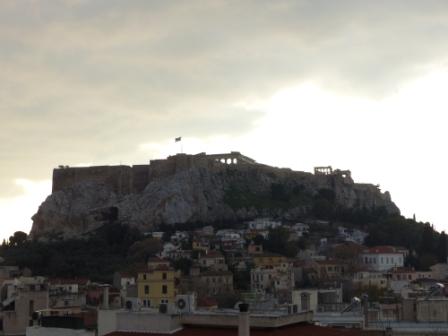
Book research has its advantages when you're the author of The Athenian Mysteries.  I and my family have been in Greece, and it's been a fun and very hectic time.  Here's the view from our hotel room. That's the Acropolis.  It was dusk when we arrived and the first thing we did was take a picture.


So now in the posts to come I will deliver some photos, descriptions, and random thoughts.  Let me begin with Tripod Road.

When I told my literary agent that we were in Athens she replied, "Walking in the steps of Nico and Diotima!"

I replied, "It's funny you should say that, because the hotel we're staying at is on Tripod Road."

In the books, my hero Nicolaos and the lovely Diotima have to walk up and down Tripod Road almost every day.  It's the main road from their house to the agora.

Tripod Road was lined with victory tripods, put up by the winners of the choral contests at the arts festival called the Great Dionysia.  Pericles himself had a victory tripod on Tripod Road, because he funded a winning play.

These days Tripod Road is called Nikodimou Street, but we know it was the original Tripod Road, because there's a single surviving tripod.  It's called the Lysikrates Monument, erected by a very happy fellow named Lysikrates to celebrate a victory at the Great Dionysia some time around 334BC, and it's known to have been built on the west side of Tripod Road.  Here it is, and it's about 100 meters down the road from where we're staying. 


Yes, I know it doesn't look remarkably like a tripod.  The victory monuments became very ornate over time.

So this means every time we walk down the road for the inevitable evening dessert of waffle and chocolate sauce, we are in fact walking in the footsteps of Nico and Diotima.


Modern Greek toilets

So with all of us recovering from excessive New Year partying, I think it's time to talk about going to the toilet.

Let me start with some modern travel advice:  it's a little known but quaint custom of modern Greece that you do not put the used paper in the toilet and flush it.  This is because Greek sewerage pipes are half the width of pipes anywhere else on the planet, and if you flush the paper, then the drain will block and that with which you thought you were permanently parted will make an unwelcome return.

Modern Greek toilets have a bin next to the bowl.  The paper goes in there, and is disposed with the other trash.  I mention this little detail because many tourists find it impossible to believe, despite the numerous signs put up by the locals begging people not to flush the paper.  (Recent buildings don't have this problem...sometimes.)

Another interesting custom is the bathroom attendant, who is to be found at many conveniences throughout the eastern Mediterranean.  Bathroom attendants have approximately the worst job in the world.  You pay this nice person a small sum at the entrance, in return for which you are given the toilet paper which you otherwise will not find within.  Tourists who don't know the system will sometimes be heard from within toilet stalls, calling plaintively for help after it's too late.

Of course, the attendant system leaves the question of how much paper you get for your money.  I recall this being a particular problem in Yugoslavia in the years before that sad country imploded.  It was quite normal to hand over your cash and receive three thin squares of forlorn paper that weren't going to stretch the distance, so to speak.  The value of the dinar was in free-fall at the time due to hyperinflation.  For the cost of the toilet paper, we calculated that it was cheaper to cut out the middleman and just use your paper money.

This is why backpacker guides sometimes advise you to carry your own rolls of paper, which then become the target of desperate thieves.


Gary and the chemical explosives

Some years ago, in 2002 I think it was, I happened to be passing through Los Angeles airport on my way for a flight back home. Airport security was considerably tighter than it used to be, but all those incredibly annoying scanners had yet to be installed.

I was randomly selected for a baggage check. (The fact that not all bags were checked tells you how long ago this was.)

Fine. I handed over my bag.

They opened it up, had a poke around, then swiped the inside with a small piece of material which they popped into a machine.

Red lights flashed! Alarms sounded! Nice men with guns appeared!

"What's wrong?" I asked.
"Sir, please step back behind the red line," said a nice man with a gun.
I stepped back behind the red line.
"What's wrong?" I repeated.
"Sir, your bag has tested positive for chemical explosives."

Well this was going to be fun! I knew I was pure as the driven snow, in this one small respect at least, so I settled in for an interesting experience.

It will come as no surprise that everything came out of the bag. Then they pulled the frame out of the bag. Then they looked inside the frame. Then they looked inside the lining. All clothing was minutely inspected. I had probably 15 or 20 books in that bag, some of them huge technical volumes. They turned every single page.

While this was going on, another nice man took my passport and wandered off with it, no doubt to ask the FBI if I was known to them. He returned while they were still flipping pages and tearing my laptop apart. He gave me a strange look, and didn't return the passport.

That's when I remembered that, not long before, I'd had to get a Federal Police security check.

The check was so I could do some work at Argyle Diamond Mine, which is the largest source of pink diamonds in the world. Once you're inside the compound, the diamonds are just lying on the ground, so they prefer to restrict visitors to honest people and successful thieves who haven't been caught yet. (While walking past swept-up heaps of small black rocks, I'd asked, "Where are the diamonds?").

But the nice men at LAX wouldn't have known that detail. All they would have known was that the Australian Federal Police had queried the FBI for a standard check on me, and the FBI had probably recorded that query. And now here I was, testing positive for chemical explosives.

After they had reduced the bag to its component atoms, they asked, "Have you ever spilled any soap or washing powder in this bag?"

As it happened, my wife and I had used this bag on our honeymoon, and washing powder had indeed been spilled. Fourteen years before.

"That must be it, then. The machine detected the phosphorus."

From fourteen years ago?

They reassembled the bag and repacked. I tried to help several times, but each time was politely but firmly told to get back behind that red line. So I watched them make a complete hash of the repack. Lumps bulged in odd places and the zipper strained. They handed back my passport. I moved to pick up the bag, but was told, "No sir, this man here--" they indicated one of their own, no doubt the most unimportant man present, "--this man will carry your bag until you get on your plane."

My new friend was having none of that. He picked up my bag, brushed past the long queue of people waiting to check in, and stopped at the front desk.

"Check this passenger in at once."

And that's how to get to the head of the queue at LAX. But I wouldn't necessarily recommend it. We threw away the bag when I got home.

Hegesistratus of Elis

Since I'm in an icky gruesome phase, here's a quote from Herodotus. Not much I can add to this.

Hegesistratus of Elis had once been arrested by the Spartans on the charge of doing them a number of injuries of a very serious nature. Flung into prison and condemned to death, Hegesistratus, realizing, in his desperate situation, not only that his life was at stake, but that he would be tortured before his execution, dared a deed which one cannot find words adequate to tell.

He was lying with one foot in the stocks--which were made of wood reinforced with iron--and somehow managed to get hold of a knife, which was smuggled into the prison. No sooner was the knife in his hands than he contrived the means to escape--and how he did it was the bravest action of all those we know: he cut off a piece of his foot, having nicely judged how much to leave in order to pull it free. Then, as the prison was guarded, he worked a hole through the wall and escaped to Tegea, travelling at night and lying up during the day in the woods. The Spartans went out in force to try to find him, but he got clear and reached Tegea on the third night. They were astonished at the man's daring when they saw half his foot lying by the stocks and yet were unable to find him.

I'd love to know what Hegesistratus did to annoy the Spartans. Whatever, it must have been spectacular.

Herodotus say Hegesistratus got himself a wooden foot made. He later went over to the Persians during the wars and became one of their seers.


My Life In Ruins

I wouldn't normally watch a romantic comedy, except maybe if it was the only alternative to taking, say, hemlock. But there I was on a big plane for 12 hours, on the first leg of the journey to Bouchercon: total transit time a bit over 25 hours in case you're wondering.

I did manage to write two scenes for the third book while in flight, but it wasn't the most inspiring environment, so I had a look at the movies. There was one called My Life In Ruins, about a tour guide who takes tourists around the ruins of Greece and inevitably finds true love.

How badly could they screw this up, I wonder. So I watch it.

I can't comment on the movie, not being a romantic comedy connoisseur, except to say if this is typical then hemlock might actually be the better alternative. But the movie went from Olympia to Delphi to the Acropolis, and to my astonishment, they shot the real sites from good angles. The heroine trots out whole sequences of facts about the sites, and as far as I could tell on the fly she got them all correct.

I'm not sure this is enough to make up for the rest of the movie though.

Off to Bouchercon

I'm off to Bouchercon tomorrow morning, leaving in 9 hours. I haven't preset any blog posts because

a) I would need too many; and

b) I'm rather hoping to blog while in the US, hotel internet connections willing.

There'll be a short delay before next post. Total travel time exceeds 24 hours, and then you have to allow time for my brain to re-congeal.

I've lost count of the number of times I've been to the US. I know it's more than 14. What'll be exciting this time is meeting the people, very different people from any previous trip: writers, fans, editors, and the odd agent.

Gary's back, for a few days at least

I am returned from a very relaxing week's holiday in the Whitsundays, on Hamilton Island, all of which is part of the Great Barrier Reef. Highly recommended, especially if you have kids.

The Whitsunday group of islands was discovered and named by Captain Cook, who US readers will know better for finding Hawaii, but in his extra time he also discovered the east coast of Australia. Hamilton Island is named for Lady Hamilton, mistress of Lord Nelson.

Cook certainly sailed the Whitsunday passage, but I never expected to see another naval vessel make the same trip. I definitely never thought to see one from the room in which we were staying:


This is an Australian Navy warship at the southern end of the passage, which we woke to see one morning. It looks like it has plenty of room, but what it's heading towards is this:

Which is another view from our room. The second view is to the left of the top one.

I have sailed these waters in a 40 foot yacht, and believe me, once you get through that gap in the second picture, there isn't a lot of water under your keel. Even at high tide there are places where you have less than a meter to spare.

So I am watching this navy ship steam up, wondering at what point it's going to ground.

The navy ship stops, backs, turns, and exits the way it came in.

What happened? Did they make a wong turn? Are our captains that incompetent? Did some junior officer blow it?

Next morning we are at the beach, and up comes the same ship. On the same course. It stops at the same point, backs, and exits the way it came.

I'm at a loss to explain, unless they were practising how to get out of a dead end, using a real dead end.

I kept writing on the holiday, and I was surprisingly productive even using a notepad and a pen and writing only when the girls were doing their own thing. I am disconcerted to report that lying on a lounge on a gorgeous tropical island, next to a pool with women wearing bikinis, I was not as distracted as I am by my internet connection at home. This is a sad commentary on my personality, but also does not bode well for the time I spend on the net. Clearly I'd be more productive if I didn't spend so much time doing netty things.

I'm not home for long. In three and a bit days I get on a plane for the US and Bouchercon.

I am slightly amazed to see my pre-positioned posts actually appeared. Thank you everyone who stayed with me! I've replied to your comments, and fun they were to read too.

Gary meets Anneke and Bill (at last!)

Many months ago, a naive and somewhat rejected amateur writer called Gary was wandering around inside a place called Second Life, an online virtual world, when he ran into a goth girl called Anneke. Anneke was a writer type too, and she told him about an in-world magazine looking for stories.

So Gary wrote a short story that he submitted to the magazine, and they accepted it. That was his first ever sale! (He'd won prizes before this, but never a sale.)

Before he submitted, he sent the story to Anneke to see what she thought. Anneke likes critiquing stories, and she has a natural talent for it. What is most amazing is, not only does she have the ability to improve someone else's story, but she can do it in English. Anneke is Dutch. Astonishing!

And so a habit developed. Every single thing I've written since then, Anneke has checked before I submitted. Every time, she's said something that improved the story. For my short stories that probably didn't take too much of her time, not enough that I feel guilty about it in any case. But then she read my novel end to end and sent me a perceptive and very useful critique. Wow! I fixed the ms as best I could.

Her own writing, in English, her second language, is very good indeed, far better than most native speakers could achieve. I hope one day she submits some of her own fiction somewhere.

In the course of time I met another writer friend of Anneke's. Bill Kirton is a Real Writer. Bill has written plays that people have actually put on. He's had piles of short stories published, and two novels, with more to come. He used to teach creative writing (and Fench) at university. It's scary how much he knows about how to deliver a gritty, tight, solid story.

Bill, a professional, offered to read my novel. He sent me a brilliant critique that pointed out important weaknesses, most of which I'd semi-realized were there but hadn't known enough to know they were weaknesses. I fixed the ms again, as best I could.

I owe Anneke and Bill a lot.

There was never the slightest chance we'd ever meet of course, because Anneke is in Amsterdam and Bill is in sunny Aberdeen. But then I announced I was visiting Europe, so we agreed to converge on London. Which we did, and I, for one, had a wonderful time meeting friends I never expected to be with in person.

I'll have to update this later with a photo; they're all on Anneke's camera.

Bill, the ultimate gentleman, insisted on paying for lunch. He also gave Anneke and I signed copies of his latest book, Rough Justice. I read it that night. Of course I already had a copy of his first book, Material Evidence, on the shelves at home.


What I like about Detective Chief Inspector Carston of the Cairnburgh force is he's a regular guy who just happens to catch killers for a living. Not a trace of detective eccentricity to be seen, but plenty of realistic characters and a murder you can believe in.

Travel Rules of the Gendarmes

After carefully observing the gendarmerie of Paris for some days, I believe I have deduced the rules of how they are expected to move about:

  1. Turn on the siren. This most important of rules applies to all but the most trivial situations. Being late for lunch is not trivial, especially in France.

  2. Have many people in the car. Two is far too few. Five gendarmes looks more impressive to the people watching you whiz by with siren blaring.
  3. Everyone in the car should look earnestly in the direction of travel. This rule must be especially important because I have never seen it broken. I expect this is to give the impression that where they are going is more important than where they are.

  4. Never use one car when three, four or five will do. Convoys of cars, sirens blaring, many men in each car, all looking forwards with intense, earnest expressions. Egads! Whatever it is, it must be important. But why does it happen several times every hour?

  5. As soon as you arrive at your destination, stand around and do nothing much. I deduce this rule from the fact that gendarmes are only seen in one of two states: either rushing about in cars, sirens blaring, or else standing about doing nothing much, often in impressively large groups (I guess that's why they need all the cars) and wearing piles of dark blue armor and armed to the hilt. As far as I'm aware, no one has ever observed them doing anything other than these two things.

The Rhythm Method

Rhythm matters a great deal in writing. You just have to have it. If you can't find the rhythm in your work, then you're probably in trouble.

Now different languages favor different rhythms in speech and writing -- I speak barely enough German to know that -- and there're pronounced differences in the natural styles of writers.

Does this mean some writers have styles that naturally fit certain languages? Maybe there are people out there who can't write in English to save their lives, but who would have been fine in Swahili, if only they knew the language?

Or are there writers who can be improved by translation? I'm thinking of Perez-Reverte on that one. I don't know a word of Spanish, so I can't speak for the original, but the translations of books like The Flanders Panel are brilliant. (If you haven't heard of him, rush out now and get The Flanders Panel, The Dumas Club, and The Dancing Master).

Where's Waldo?

I'm travelling about Europe with my family, which is why my blogging frequency is now approaching zero.

Looking about local bookstores in Germany and Switzerland, it struck me what a disaster it must be for a good writer to be born into a place where few people use the language. A fairly large number of books in the local Buchhandlerung are translations from English language works. Considering how little money there seems to be for English language writers, even given the huge English language reading public, the income of a German or, OMG, Czech or Turkish author must be miniscule. How do these people cope?