Cherries have been around since forever. Cherry stones regularly appear at neolithic sites across Europe and the Middle East. Back in those days of course they were all wild cherries.
The earliest mention of cultivating cherries comes from classical Greece. It's in a book called Enquiry Into Plants by a chap named Theophrastus. Theophrastus was a student of Aristotle (who was in turn taught by Plato, whose teacher was Socrates, who was taught by Diotima.) This puts him about a hundred years after the time of Nico and Diotima.
It's clear from his text that cherry orchards have been around for some time. The dating on the first cherry orchard can be bookended because cherries don't get a mention in Hesiod's book Works and Days. Hesiod is more or less the same date as Homer, and Works and Days is like the archaic Greek version of The Dummy's Guide to Farming. Cultivated cherries probably are a late archaic or a classical creation.


Sabazios
Sabazios sounds like a name that should belong to a composer of classical music, but he is in fact an ancient Phrygian god. The cult of Sabazios made it into Athens some time in the mid-400s BC. Which we know for sure because by the end of the 400s Aristophanes had written a play (now lost) in which Sabazios is ejected from the city.
The odd thing is that although the Athenians were extremely tolerant of other religions, they disliked this particular cult. The orator Demosthenes once attacked a political enemy by claiming he partook in rites to Sabazios. The clear implication was that anyone who worshiped Sabazios was a disreputable crackpot.
Demosthenes also says the rites involved frenzied dancing while holding snakes and chanting, "Euoi saboi! Euoi saboi!"
The -zios part of Sabazios is cognate with the Greek Zeus and the Latin Deus. Despite which, the Greeks associated Sabazios with Dionysos. Herodotus refers to the Phrygians worshipping Dionysos in contexts where he clearly means Sabazios.
The most viable explanation is that in Phrygia, Sabazios was a god of the harvest and of barley in particular, thus probably with beer making. Aristophanes in one of his comedies refers to "the sleep of Sabazios" to mean guardsmen who've drifted off after drinking. While in Athens, Dionysos was the god of the harvest and of wine.
There are problems with this though. Archaic images of what's believed to be Sabazios show him on horseback and carrying a staff, which isn't particularly agricultural. Even well into Roman times, the rites of Sabazios continued to involve orgiastic dancing while holding live snakes. While this sounds like fun, the snakes are not even remotely agricultural.
Finally, every shrine to Sabazios had its own Hand. The Hand was always a sculpture, shown upright, in a pose of benediction that might look familiar to modern church goers. Here are some hands of Sabazios:

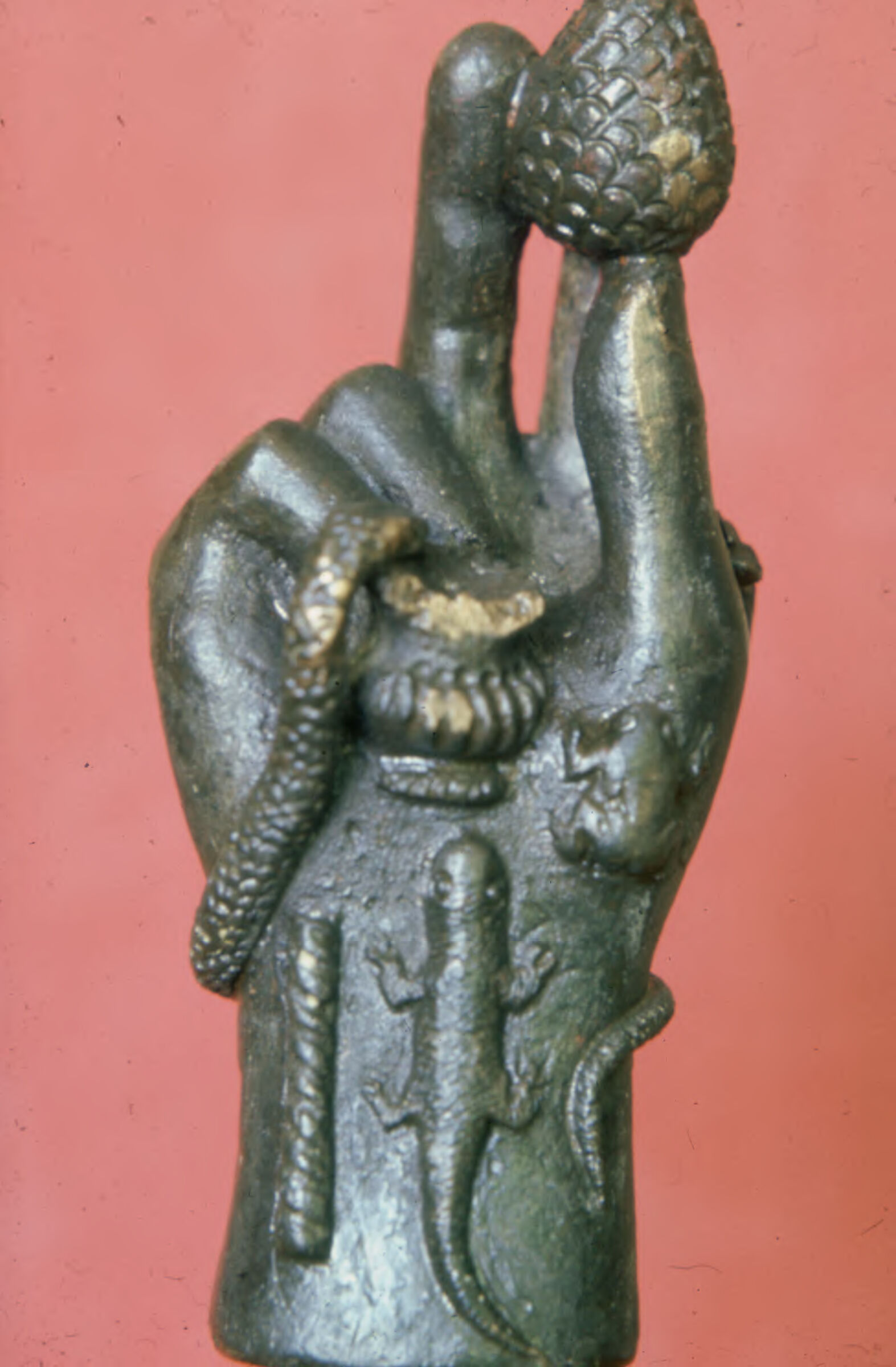
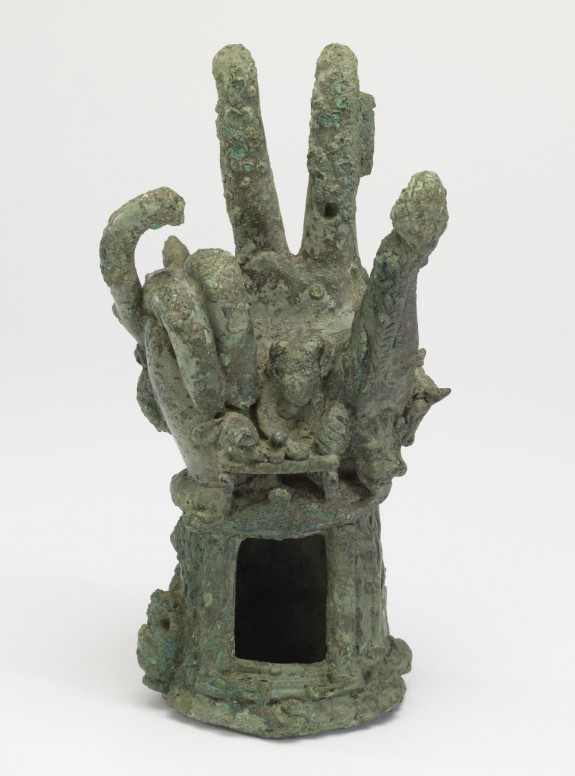
These are from the British Museum, Harvard, and the Walters Museum. The Hand of Sabazios usually holds something, an acorn or a snake or sometimes even a small figure.
The odd thing is that although the Athenians were extremely tolerant of other religions, they disliked this particular cult. The orator Demosthenes once attacked a political enemy by claiming he partook in rites to Sabazios. The clear implication was that anyone who worshiped Sabazios was a disreputable crackpot.
Demosthenes also says the rites involved frenzied dancing while holding snakes and chanting, "Euoi saboi! Euoi saboi!"
The -zios part of Sabazios is cognate with the Greek Zeus and the Latin Deus. Despite which, the Greeks associated Sabazios with Dionysos. Herodotus refers to the Phrygians worshipping Dionysos in contexts where he clearly means Sabazios.
The most viable explanation is that in Phrygia, Sabazios was a god of the harvest and of barley in particular, thus probably with beer making. Aristophanes in one of his comedies refers to "the sleep of Sabazios" to mean guardsmen who've drifted off after drinking. While in Athens, Dionysos was the god of the harvest and of wine.
There are problems with this though. Archaic images of what's believed to be Sabazios show him on horseback and carrying a staff, which isn't particularly agricultural. Even well into Roman times, the rites of Sabazios continued to involve orgiastic dancing while holding live snakes. While this sounds like fun, the snakes are not even remotely agricultural.
Finally, every shrine to Sabazios had its own Hand. The Hand was always a sculpture, shown upright, in a pose of benediction that might look familiar to modern church goers. Here are some hands of Sabazios:
These are from the British Museum, Harvard, and the Walters Museum. The Hand of Sabazios usually holds something, an acorn or a snake or sometimes even a small figure.
The teenager's guide to WW1
My teenage daughter's current assignment in her history class is to write a war correspondent report from the trenches of Gallipoli during WW1. While I wouldn't normally stick into this blog anything that was both family and school, I can't resist her first draft; I herewith give you a teenager's take on WW1:
HEY STEFFO!!!
We’re here in this stupid &#^#%@ bay and all about to die L except everyone’s trying to be all honourable and we’re just like meh.
The Turks aren’t very good at aiming coz we’re all still alive.
I miss my teddy bear, and my nice warm bed. Trenches are like SO unfashionable.
Day to day fighting includes the same routine as everywhere else: Aim, fire, shoot, duck. Repeat.
If this telegram is sent you in error please do NOT (repeat NOT) serve it with broccoli. It should instead be lightly stewed for best results add sugar. Thankyou.
Love from
Falshywalshy Official War Idiot Correspondent who volunteered for this (that was dumb o.o)
PS. Someone just died next to me. I suspect oxygen suffocation from laughter.
Your story begins on page 100: a cool critique letter by Robert Heinlein
This might interest the writers among us. The Mote in God's Eye is a very famous SF novel written by Larry Niven and Jerry Pournelle back in 1973. They sent the manuscript to Robert Heinlein to check over. Heinlein's regarded by many as the greatest SF author ever, and at that time he was at the height of his powers.
Heinlein was so fascinated by The Mote in God's Eye that he spent five days reading and critiquing the ms, then he sent back a 17 page letter that clinically pointed out Niven and Pournelle's copious errors.
Quite by accident I discovered Heinlein's critique is online at The Virginia Edition. Virginia was the name of Heinlein's wife and this appears to be a site publishing Heinlein's complete works. In any case the link goes to a PDF sampler that includes the critique. Open the PDF, scroll down to page 15 and start reading.
What struck me is that Heinlein's critique reads much like the best sort of responses that you find within critic groups these days. The difference being that this one's written by one of last century's most successful authors.
There are phrases in there that will resonate with most authors, and will definitely resonate with my literary agent. Phrases such as, "Your story begins on page 100." Heinlein lays into Niven and Pournelle for their poor English (two ultra-respected authors, mind you!). He was a former naval officer and he dissects their naval etiquette in detail. But mostly it's the way he thinks in terms of what makes a book work that I find instructive. Plus these words of sage advice: "Cut, cut, cut."
I'd suggest reading the book first. It's long but will reward you. Then read the critique. You can actually see where Heinlein's advice changed the novel.
The book went on to become a bestseller.
Heinlein was so fascinated by The Mote in God's Eye that he spent five days reading and critiquing the ms, then he sent back a 17 page letter that clinically pointed out Niven and Pournelle's copious errors.
Quite by accident I discovered Heinlein's critique is online at The Virginia Edition. Virginia was the name of Heinlein's wife and this appears to be a site publishing Heinlein's complete works. In any case the link goes to a PDF sampler that includes the critique. Open the PDF, scroll down to page 15 and start reading.
What struck me is that Heinlein's critique reads much like the best sort of responses that you find within critic groups these days. The difference being that this one's written by one of last century's most successful authors.
There are phrases in there that will resonate with most authors, and will definitely resonate with my literary agent. Phrases such as, "Your story begins on page 100." Heinlein lays into Niven and Pournelle for their poor English (two ultra-respected authors, mind you!). He was a former naval officer and he dissects their naval etiquette in detail. But mostly it's the way he thinks in terms of what makes a book work that I find instructive. Plus these words of sage advice: "Cut, cut, cut."
I'd suggest reading the book first. It's long but will reward you. Then read the critique. You can actually see where Heinlein's advice changed the novel.
The book went on to become a bestseller.
Bunnies, eggs and Easter
It seems to have become a tradition that every year at this chocolatey time I talk about what Easter bunnies and Easter eggs have to do with the death and resurrection of Jesus.
The answer is, nothing at all! The word Easter comes from a Germanic pagan fertility Goddess called Eostre, if you speak Old English, or Ostara, if you speak Old High German. It just so happens that the month we call April, the people who spoke Old English called Eostre's Month.
The first mention in history of the original Easter festival comes from no less than the Venerable Bede, a brilliant monk who lived in England in the 600s AD. Bede was a major player in the hot subject of his day: how to calculate when the death and rebirth of Jesus should be celebrated. He wrote a book about it called De Ratione Temporum which means On Calculating Time.
Bede's calculation landed the Christian event in Eostre's Month (April!). Bede commented in the same book, in an almost offhand way, that Eostre's Month traditionally saw the locals hold festivals in honour of the pagan goddess Eostre.
Bunnies are particularly good at doing the fertility thing, and eggs have the obvious meaning. Bunnies and eggs therefore are the symbols of the German fertility goddess. This all got mixed up with the Christian event and since no one in their right minds turns down chocolate, I don't think they'll be separating any time soon.
I went looking for a decent translation of Bede's original comment and the best I could find was from tertullian.org, who in turn got it from a translation by Faith Wallis, Liverpool University Press 1988, pp.53-54.
Happy Eostre / Ostara / Easter !
The answer is, nothing at all! The word Easter comes from a Germanic pagan fertility Goddess called Eostre, if you speak Old English, or Ostara, if you speak Old High German. It just so happens that the month we call April, the people who spoke Old English called Eostre's Month.
The first mention in history of the original Easter festival comes from no less than the Venerable Bede, a brilliant monk who lived in England in the 600s AD. Bede was a major player in the hot subject of his day: how to calculate when the death and rebirth of Jesus should be celebrated. He wrote a book about it called De Ratione Temporum which means On Calculating Time.
Bede's calculation landed the Christian event in Eostre's Month (April!). Bede commented in the same book, in an almost offhand way, that Eostre's Month traditionally saw the locals hold festivals in honour of the pagan goddess Eostre.
Bunnies are particularly good at doing the fertility thing, and eggs have the obvious meaning. Bunnies and eggs therefore are the symbols of the German fertility goddess. This all got mixed up with the Christian event and since no one in their right minds turns down chocolate, I don't think they'll be separating any time soon.
I went looking for a decent translation of Bede's original comment and the best I could find was from tertullian.org, who in turn got it from a translation by Faith Wallis, Liverpool University Press 1988, pp.53-54.
Eosturmonath has a name which is now translated "Paschal month", and which was once called after a goddess of theirs named Eostre, in whose honour feasts were celebrated in that month. Now they designate that Paschal season by her name, calling the joys of the new rite by the time-honoured name of the old observance.
Happy Eostre / Ostara / Easter !
Military reconstructionists
I've previously said that for book research I prefer to trust original ancient sources over modern ones, but there's one field where I would never dare to question the modern experts, and that's the people who are into military re-enactment. I don't think there's anyone more into getting details right than these guys.
You've probably heard of the Society for Creative Anachronism. SCA is more mediaeval than ancient, though it does have its ancient enthusiasts. SCA covers all the aspects of past times, but anyone who's ever been to a SCA festival could tell you it's the skirmish combats that get the crowds.
There are similar re-enactment groups who're more ancient oriented, though the organisations don't seem to be as closely knit so if you're interested you'd need to google around for what's in your area. Most of them are into Roman army reconstruction but there are some Greek Hoplite groups too.
A good place to start would be Ancient Warfare Magazine. I'm pretty sure most of the people who write or read it are into doing re-enactments. (No, I don't do this myself, but it's fun to watch.)
Despite its name, the Roman Army Talk forum has a substantial Greek section. These guys are awesome for minute details about how people used to slaughter each other. If you want the pros and cons of holding your spear overhand vs underhand, then this is the place to be. Their knowledge of military history would rival that of any Oxford don.
I don't need this sort of information very often, because Nico's not into regular army life. When he gets into a fight, it's invariably a street brawl in some grotty back alley, or else a tavern brawl (I had such fun writing the barroom fight in Ionia Sanction).
But when I do need soldierly detail, the re-enactors have the advantage that they've actually tried out in real life the stuff that's mentioned in original sources. They bring a certain practicality to the subject that makes it easier to sort out from the original sources what's likely true and what might be false.
You've probably heard of the Society for Creative Anachronism. SCA is more mediaeval than ancient, though it does have its ancient enthusiasts. SCA covers all the aspects of past times, but anyone who's ever been to a SCA festival could tell you it's the skirmish combats that get the crowds.
There are similar re-enactment groups who're more ancient oriented, though the organisations don't seem to be as closely knit so if you're interested you'd need to google around for what's in your area. Most of them are into Roman army reconstruction but there are some Greek Hoplite groups too.
A good place to start would be Ancient Warfare Magazine. I'm pretty sure most of the people who write or read it are into doing re-enactments. (No, I don't do this myself, but it's fun to watch.)
Despite its name, the Roman Army Talk forum has a substantial Greek section. These guys are awesome for minute details about how people used to slaughter each other. If you want the pros and cons of holding your spear overhand vs underhand, then this is the place to be. Their knowledge of military history would rival that of any Oxford don.
I don't need this sort of information very often, because Nico's not into regular army life. When he gets into a fight, it's invariably a street brawl in some grotty back alley, or else a tavern brawl (I had such fun writing the barroom fight in Ionia Sanction).
But when I do need soldierly detail, the re-enactors have the advantage that they've actually tried out in real life the stuff that's mentioned in original sources. They bring a certain practicality to the subject that makes it easier to sort out from the original sources what's likely true and what might be false.
The Brazen Bull
Here's another exotic way to die horribly. (If you're wondering why I so often return to this subject...you've come to the web site of a murder mystery author.)
Cicero and Diodorus get into the act a few hundred years later. Between them they say that the brazen bull was eventually captured by the Carthaginians who took if back to Carthage. Since the Carthaginians most certainly did practice human sacrifice, there's a fair chance the brazen bull saw continued use. It was later returned to its home by Scipio after he conquered Carthage, after which the brazen bull somewhat thankfully disappears from history.
The scene is Acragas, a city in Sicily. The time is about a hundred years before Nico and Diotima, so we're talking 6th century BC. Back then Sicily was Greek and Acragas was ruled by a tyrant named Phalaris, who was renowned for his cruelty.
In fact, the reputation of Phalaris was so well-known that an Athenian by the name of Perillos came to the tyrant with a suggestion. Why not, he said, build a bull out of hollowed bronze? The tyrant's enemies could be shut inside and then a fire set underneath the brazen beast's body so that the tyrant's enemies roasted to death.
Phalaris thought roasted enemy was a terrific idea. He commanded Perillos to build the brazen bull. The statue had a door in the side for easy access. Pipes were installed inside that ran to a horn in the bull's mouth, so that the victim's screams would emerge as a bull's roar.
Quite why Perillos came to the tyrant with the idea in the first place is unknown, but presumably he was either in it for the money or else was a fellow-traveling sadist. Either way, legend has it that when the bull was ready for its first run, that Phalaris the Tyrant ordered Perillos be the first victim. This is so neatly according to the usual narrative that it's probably an invention.
The brazen bull, however appears to have been a for-real instrument of torture. No less than Pindar mentions it in a praise song, a hundred years after the event. (This is the same Pindar who appears in Sacred Games, which is what brought the whole story to my attention.) Pindar had this to say:
The kindly excellence of Croesus does not perish, but Phalaris, with his pitiless mind, who burned his victims in a bronze bull, is surrounded on all sides by a hateful reputation.Pindar takes it for granted that everyone knows the story of the brazen bull. Phalaris clearly had a public relations problem.
Cicero and Diodorus get into the act a few hundred years later. Between them they say that the brazen bull was eventually captured by the Carthaginians who took if back to Carthage. Since the Carthaginians most certainly did practice human sacrifice, there's a fair chance the brazen bull saw continued use. It was later returned to its home by Scipio after he conquered Carthage, after which the brazen bull somewhat thankfully disappears from history.
Publishers Weekly starred review for Sacred Games
"Corby integrates the political intrigue of the day
with fair-play plotting and welcome doses of humor. Fans of Steven
Saylor's Gordianus novels will be enthralled."
This review of Sacred Games appeared in today's issue of Publisher's Weekly. The review was starred (which is a cherry on top) and placed in its own box (which is extra whipped cream). Reviews are always a précis followed by a verdict, and let me tell you, it's the verdict that an author's eyes always lock onto in the first micrososend.
Here's the entire thing:
The Olympic Games of 460 BCE form the backdrop for Australian author Corby's third mystery featuring Athenian investigator Nicolaos (after 2011's The Ionia Sanction), his best thus far.
Before they even begin, Nico's oldest friend, Timodemus, a martial arts champion, is goaded into a public fight by his fiercest rival, a Spartan named Arakos. That confrontation makes Timodemus the prime suspect after Arakos is found battered to death.
Desperate to save his friend from summary execution, Nico manages to convince "the ten Judges of the Games" to give him several days to find the truth. Doing so could avert a war between Athens and Sparta.
Partnered with a Spartan, Markos, to avert bias in his findings, and aided by his feisty fiancée, Diotima, Nico has an especially twisted path to tread to reach an answer in time.
Corby integrates the political intrigue of the day with fair-play plotting and welcome doses of humor. Fans of Steven Saylor's Gordianus novels will be enthralled.
Free copies of Sacred Games for US readers!
The lovely people at Soho Press are giving away 40, yes forty, copies of Sacred Games.
To enter, you need to go to the giveaway page on GoodReads by clicking on this link. Then follow the bouncing ball.
These copies are all ARCs. Which means Advance Reader Copies. Which means they were printed before copyedits. Which means you get to see the Genuine Typos™ that were in the manuscript when I submitted it. (In fact, it's remarkably clean.).
Offer closes 5th March!
To enter, you need to go to the giveaway page on GoodReads by clicking on this link. Then follow the bouncing ball.
These copies are all ARCs. Which means Advance Reader Copies. Which means they were printed before copyedits. Which means you get to see the Genuine Typos™ that were in the manuscript when I submitted it. (In fact, it's remarkably clean.).
Offer closes 5th March!
Drug addiction in ancient Greece
For no obvious reason, this occurred to me today: that there's no real mention of drug addiction in the classical world.
It's not because of ancient drug laws, because there weren't any. Nor is it necessarily due to lack of drugs, although the choice was a lot more limited. Herodotus mentions that the Scythians used to throw hemp seeds on the hot stones of their steam baths. But nowhere does anyone mention Scythians becoming so addicted to their baths that they refused to leave them.
Alcohol was in plentiful supply, to put it mildly. In fact wine was probably safer to drink than the water. There were many drunken parties every week. But you're hard pressed to read of anyone being described as a drunkard until you get to Roman times.
The men of Alexander's army are described as frequently and copiously drunk, but this didn't stop them from conquering the entire known world. They performed very well indeed and don't seem to have craved drink so much as consumed it whenever it was available. Alexander did, in a drunken rage, kill one of his friends, but notice that even while blind drunk he was functioning quite well.
Men like Alcibiades were famed for their dissolute lifestyles, but no one suggested for a moment that their bad habits impaired their function. Quite the opposite in fact; men marveled that Alcibiades could live as he did and not only still stand up, but also be a great leader.
Painkiller abuse was possible. Hemlock is a powerful painkiller if you don't mind teetering on the brink of death. (Sort of like a lot of modern drugs, really.) The number of people reported for hemlock abuse is, as far I know, zero.
Ditto for poppy juice, which is much closer to modern drugs. They knew how to make it, and there's speculation it may have played a part with some oracles, yet I can't think of an instance where anyone wrote, "So-and-so was addicted to the juice of the poppy."
Why the lack of junkies? It might be because junkies don't tend to make it into history books. Yet there are other periods when such people did. It might be because natural selection eliminated addictive personalities very quickly in the ancient world. My own theory, formed after at least ten minutes of deep thought, is that the ancient Greeks were simply so into looking after themselves physically, and worshiped good physical condition to such an extent, that anyone who deliberately neglected their own health was simply lower than low. I can't imagine a classical Greek forgiving anyone for substance abuse. The society pressure to not do it was just that much greater.
(Of course, now that I've mentioned it, someone will probably come up with a hundred famous classical junkies...)
It's not because of ancient drug laws, because there weren't any. Nor is it necessarily due to lack of drugs, although the choice was a lot more limited. Herodotus mentions that the Scythians used to throw hemp seeds on the hot stones of their steam baths. But nowhere does anyone mention Scythians becoming so addicted to their baths that they refused to leave them.
Alcohol was in plentiful supply, to put it mildly. In fact wine was probably safer to drink than the water. There were many drunken parties every week. But you're hard pressed to read of anyone being described as a drunkard until you get to Roman times.
The men of Alexander's army are described as frequently and copiously drunk, but this didn't stop them from conquering the entire known world. They performed very well indeed and don't seem to have craved drink so much as consumed it whenever it was available. Alexander did, in a drunken rage, kill one of his friends, but notice that even while blind drunk he was functioning quite well.
Men like Alcibiades were famed for their dissolute lifestyles, but no one suggested for a moment that their bad habits impaired their function. Quite the opposite in fact; men marveled that Alcibiades could live as he did and not only still stand up, but also be a great leader.
Painkiller abuse was possible. Hemlock is a powerful painkiller if you don't mind teetering on the brink of death. (Sort of like a lot of modern drugs, really.) The number of people reported for hemlock abuse is, as far I know, zero.
Ditto for poppy juice, which is much closer to modern drugs. They knew how to make it, and there's speculation it may have played a part with some oracles, yet I can't think of an instance where anyone wrote, "So-and-so was addicted to the juice of the poppy."
Why the lack of junkies? It might be because junkies don't tend to make it into history books. Yet there are other periods when such people did. It might be because natural selection eliminated addictive personalities very quickly in the ancient world. My own theory, formed after at least ten minutes of deep thought, is that the ancient Greeks were simply so into looking after themselves physically, and worshiped good physical condition to such an extent, that anyone who deliberately neglected their own health was simply lower than low. I can't imagine a classical Greek forgiving anyone for substance abuse. The society pressure to not do it was just that much greater.
(Of course, now that I've mentioned it, someone will probably come up with a hundred famous classical junkies...)
Subscribe to:
Posts (Atom)