This blog is moving to a new home!
I've been totally silent over the last couple of months for a few reasons, one of which was that we were traveling around Greece and Italy. (Yes, it really was book research. Honestly!)
I'll be writing more about that soon.
Another reason is that I've been intermittently working on a new home for my web site.
Some time ago my elder daughter looked at this site and said, "Dad, your blog looks so 2010."
Well, I certainly wouldn't want to look so old-fashioned.
The new site is a bit different, though it's hard to make a basic blog look much like anything other than a basic blog. I got the blog posts migrated over the weekend, which was lots of fun since there are 500+, believe it or not. There are still more broken links than I would like, but I think it's good enough to move.
The new site should be a lot more phone-friendly, which is a bonus.
At some point in the next couple of days I will redirect GaryCorby.com to the new home. Everything else will happen auto-magically.
As Nico would say, "Of course it will work. What could possibly go wrong?"

Showing posts with label Tech Stuff. Show all posts
Showing posts with label Tech Stuff. Show all posts

500,000 hits
This blog has passed half a million hits.
When I started it, I thought one or two, or perhaps as many as five people might be interested in odd facts about the ancient world. It turns out there are slightly more of us than I thought.
Thanks for reading!
When I started it, I thought one or two, or perhaps as many as five people might be interested in odd facts about the ancient world. It turns out there are slightly more of us than I thought.
Thanks for reading!
I thought as much
I know funny error messages on web sites are common, but this one confirms something I've long suspected. This from one of GOOGLE's own services:
500 Internal Server Error
Sorry, something went wrong.
A team of highly trained monkeys has been dispatched to deal with this situation.
If you see them, show them this information: ...
500 Internal Server Error
Sorry, something went wrong.
A team of highly trained monkeys has been dispatched to deal with this situation.
If you see them, show them this information: ...
Death of the China Bots
Something changed on the net a few weeks ago that I think is rather interesting. If you run a web site you might have noticed the same. The Chinese bots suddenly disappeared from my blog.
Web site stats for a long time now have been flooded with obvious robots, all running out of China, flooding every web site with hits. I presume they're looking for anywhere they can put spam. Or a more sinister interpretation would be they're probing for weaknesses to break in. Since the Chinese government runs one of the most repressive firewalls in the world I can only assume it's being done with government approval.
Then a few weeks ago, suddenly, overnight, the number of hits from Chinese bots fell to almost zero. It might have been a random glitch, except it stayed at almost zero for days that turned into weeks. Now I'm seeing the bot numbers slowly creep up again. But they're still less than 10% of what they used to be.
I can only suggest one of these possibilities:
- All of China has decided I am boring. This is quite possible.
- The Chinese government has decided to block their online criminals. This is incredibly unlikely.
- Western nations have quietly decided to block the packets of Chinese spammers and cyber criminals. Since this would require western governments to make a sensible decision about the net it is virtually impossible.
- Google has quietly blocked the Chinese spammers from their servers. This is quite likely. A lot of those bots are used to artificially click ad links to make money for the web sites. What you do is create a zillion web sites with ad and buy links to major stores. Then for a few thousand dollars you rent from a cyber criminal a botnet to click your links tens of millions of times and thus make a few hundred thousand dollars in revenue. Which is ripping off Google's customers. So it makes sense that Google might have decided to block the bots.
I'd be interested to know what's happening.
The (fictional) distribution of death
Here's a fun idea. My publisher Soho has put a map on their web site showing the location each of their authors uses in their books. The map's on the front page of their crime imprint. It doesn't locate the author, it locates the books.
So it's effectively a scene of the crime map!
What's interesting is the distribution of death across the globe. There are some clear inferences:
If you're worried about being slaughtered by a Soho author, you should avoid traveling to Europe. The whole place is just a hotbed of crosses on the map.
China and East Asia in general is another good place to avoid.
You'll be perfectly safe in Russia. Also most African states, the Ukraine, New Zealand and Mongolia.
There's no point trying to hide in the South Pacific. Someone died in the Solomon Islands.
Australia has a surprisingly high murder rate for the population. (Don't blame me! I contributed to the European body count.)
America has a remarkably low murder rate. The Euro-to-US ratio is the complete opposite of reality. I wonder why?
The NSA Line Eater
With all the excitement at the moment about the NSA watching your internet traffic, I can't resist adding a bit of folklore from the early days of the internet.
Back in the good old days before web pages, the standard system of community chatter were newsgroups. In fact newsgroups still exist. The newsgroup for mystery novels for example is rec.arts.mystery.
There was a bug in the original newsgroup system, so that sometimes one or two lines from a posting might randomly disappear.
This instantly gave rise to the belief that a creature lived inside the internet, and that it survived by eating random lines of text. The creature was dubbed the Line Eater. People even added what was called Line Eater Food into their posts to make sure the creature had enough to eat.
I first became aware of the Line Eater in the mid-eighties (I'm showing my age here); the Line Eater lived for a few more years, until it was finally extinguished when someone found the bug. I'm stretching my memory, but I think it was that if a line was exactly 80 characters long and began with whitespace then the newsgroup software overwrote the buffer and simply dropped that line.
RIP the Line Eater.
The Line Eater inspired another theory: that the NSA was reading all the posts in every single newsgroup, and that the missing lines were the proof. This became known as the NSA Line Eater and was much more sinister. The anarchy-oriented denizens of the internet began adding what they called NSA Food to the signatures of all their posts. They added words like KGB, bomb, assassin, and, of course, NSA, all designed to tweak the interest of the eavesdroppers. This was all very silly, but since the early netizens were uni students, that's par for the course.
Except that as it turned out, the NSA really was reading all the posts. It was part of a massive traffic analysis system called ECHELON. Traffic analysis means keeping an eye on who's talking to whom without necessarily reading the messages. ECHELON was a Cold War construct run by the US, UK, Canada, Australia and New Zealand. I wouldn't be at all surprised if this Prism thingy turns out to be merely a subset of Echelon, which has been running for at least fifty years.
350,000
Something odd happened last night. As of a few hours ago, 350,000 different people have visited this web site.
That's 350K as measured by unique internet address. My regular readers probably use several different addresses, but since we've crossed by a thousand or so it probably comes out in the wash.
I never guessed when I started that it would get so much attention. I thought a few history nerds might drop in from time to time. Who are you, and what are you doing here? I offer these observations, based on the stats:
Not many of you comment. Thanks so much to the lovely people who do leave a word or two. There've been some absolutely stunning conversations that leave me amazed at your cleverness and knowledge. In fact, when it comes to brainpower, you guys are scary.
A lot of you are doing homework. (Hi kids!) How do I know that? From the search expressions that bring you here. Speaking of which...
I am #1 on Google for the search term "ancient Greek toilet". Says it all, really.
A surprising number of you want to know how to use autocorrect in Word. Even more of you want to convert all your letters to uppercase.
The most popular posts overall are the ones about bizarre ways to die. Though the people who visit those via search engines usually just read them and go. Maybe it was something I said.
About 8,000 of you are in China, which is rather odd considering there's no Chinese edition. Either that, or I've sold 8,000 English edition books in China that I'm not aware of. Or maybe they have the world's largest ancient history class. I suppose we must hope for the last.
Only a handful of you are Greek!
I'm still puzzling over why so much of the comment spam that I have to eliminate points to divorce lawyers in America. Is there something about ancient history that causes divorce?
Illegal combination of beef with black bean sauce
I told my daughters this story from my past, and they insisted I write it here...
A long time ago I used to work for a small company called Softway, that got operating systems to work on newly invented computers. Mostly we ported Unix to new hardware, since Unix was the most popular operating system. The ubiquitous Linux of modern times is based on Unix, so if you think Linux you've got the right idea.
At one time we had a contract to get Unix running on a new line of minicomputers designed and built by a US company called Edge Computing. They've long since gone out of business, but at the time Edge had sold a lot of machines to a US government department called NASA. We just had to get Unix running on these boxes.
Now system programmers tend to work hours normally associated with vampires, and there weren't many restaurants open to feed us late at night. We often ended up at a local Chinese place. One night one of us ordered the beef with black bean sauce. I can't recall, but I think it might have been me.
One of our number fancied himself a culinary expert. He complained loudly that beef with black bean sauce is not a valid Chinese dish. Which is true. Every Chinese restaurant in the world serves beef with black bean sauce, but you'll never find it offered in China where it's supposed to come from.
Later that night, said culinary expert called us all over to his workstation. Unix is written in the C programming language. A very common error message that you get in C is this:
You don't care what it means, but he had changed it on the new computer so that, after 17 instances of the real message, the computer would instead print this:
When printed in system font they were the same length. We all thought this was hilarious, as such things always are at one in the morning, and went back to our work. We duly finished the job, shipped a working operating system to Edge, who in turn shipped loads of computers to NASA.
About 6 months later, we get a phone call from NASA. They're getting a funny error message that says, "Illegal combination of beef with black bean sauce." They want to know what it means.
We explain that beef with black bean sauce is not a valid Chinese dish.
We sheepishly admit that it's a joke we forgot to remove, that slipped through our final tests.
We are not popular, because it also slipped past the acceptance tests of Edge Computing, who signed it off and whose QA people now look like idiots. NASA is not amused. The wrong error message is clearly no danger to anyone, but among other things they're using these systems to design bits that fly in the space shuttle. If this got through, then what other problems could be lurking in there?
So we had to test the thing all over again! And luckily for us, though we did pick up some minor problems, there was nothing serious. This incident inspired me in later years, when I was running projects, to deliberately insert errors into systems to determine how well the testers had done their job. By measuring how many deliberate errors were found, you could get a statistical measure for how many real errors remained.
A long time ago I used to work for a small company called Softway, that got operating systems to work on newly invented computers. Mostly we ported Unix to new hardware, since Unix was the most popular operating system. The ubiquitous Linux of modern times is based on Unix, so if you think Linux you've got the right idea.
At one time we had a contract to get Unix running on a new line of minicomputers designed and built by a US company called Edge Computing. They've long since gone out of business, but at the time Edge had sold a lot of machines to a US government department called NASA. We just had to get Unix running on these boxes.
Now system programmers tend to work hours normally associated with vampires, and there weren't many restaurants open to feed us late at night. We often ended up at a local Chinese place. One night one of us ordered the beef with black bean sauce. I can't recall, but I think it might have been me.
One of our number fancied himself a culinary expert. He complained loudly that beef with black bean sauce is not a valid Chinese dish. Which is true. Every Chinese restaurant in the world serves beef with black bean sauce, but you'll never find it offered in China where it's supposed to come from.
Later that night, said culinary expert called us all over to his workstation. Unix is written in the C programming language. A very common error message that you get in C is this:
Illegal combination of pointer and integer types
You don't care what it means, but he had changed it on the new computer so that, after 17 instances of the real message, the computer would instead print this:
Illegal combination of beef with black bean sauce
When printed in system font they were the same length. We all thought this was hilarious, as such things always are at one in the morning, and went back to our work. We duly finished the job, shipped a working operating system to Edge, who in turn shipped loads of computers to NASA.
About 6 months later, we get a phone call from NASA. They're getting a funny error message that says, "Illegal combination of beef with black bean sauce." They want to know what it means.
We sheepishly admit that it's a joke we forgot to remove, that slipped through our final tests.
We are not popular, because it also slipped past the acceptance tests of Edge Computing, who signed it off and whose QA people now look like idiots. NASA is not amused. The wrong error message is clearly no danger to anyone, but among other things they're using these systems to design bits that fly in the space shuttle. If this got through, then what other problems could be lurking in there?
So we had to test the thing all over again! And luckily for us, though we did pick up some minor problems, there was nothing serious. This incident inspired me in later years, when I was running projects, to deliberately insert errors into systems to determine how well the testers had done their job. By measuring how many deliberate errors were found, you could get a statistical measure for how many real errors remained.
And now for something completely different...
A little while ago I mentioned on twitter the rumour that CERN will announce discovery of the Higgs particle next week.
It's only a rumour, okay? But I got a few questions from people wanting to know what's a Higgs particle and why does anyone care? So here's the (long) summary:
You know all matter is made of molecules. A couple of hundred years ago people thought molecules must be the fundamental smallest building blocks of the universe. But then it turned out there were teensier things called atoms.
You can make all the millions of different types of molecule from only 92 different types of atom (number 92 is uranium). For a while people thought atoms must be the fundamental smallest building blocks of the universe, but then it turned out that atoms had internal structure. There were teensier things called particles.
All atoms are made up of three different particles: protons, neutrons and electrons. The protons and neutrons stick together in the centre while the electrons whizz around the outside. For a while people thought these three particles must be the fundamental smallest building blocks of the universe, but then it turned out there were actually hundreds of these supposedly fundamental particles. Most of them have been given bizarre names, like the W particle, and the muon antineutrino, &/etc.
Then some of those "fundamental" particles showed signs of having internal structure.
That was kind of depressing because you might be noticing a trend here. Physicists began to wonder if this chain of teensier and teensier things would ever end.
A fellow by the name of Murray Gell-Mann realized that, if you set aside 4 special particles to carry the known forces, and 6 particles that apparently had zero size (they're called leptons...the electron's one of those), then all the other particles could be explained by combining just 6 very weird looking things that he called quarks. Gell-Mann was a huge fan of James Joyce, and quark is one of the made-up words in Finnegan's Wake.
This idea was unbelievably successful. Using 6 quarks, 6 leptons, and 4 force carriers, you could cook them in different combinations to make every particle ever observed; hence build every atom; hence build every molecule; hence build everything. What's more, the model allowed for combinations that made particles no one had ever seen before. Physicists went looking for these, and promptly found every one of them, and never found anything that didn't fit.
So this is now known as the Standard Model. Though I've called these things particles, when you do the mathematics behind this you treat all these things like fuzzy, amorphous blobs that only behave like particles when you look at them from far enough away. When you look at them up close, they behave like fuzzy amorphous blobs. The official name for the amorphous blobs is Quantum Field Theory.
The Standard Model doesn't explain why everything has mass. Mass is the stuff that, when you kick something and it fails to move quickly, you stub your toe. Mass is the reason why everything resists moving when you push it.
A bunch of guys thought about this, among them a certain Professor Higgs. (That's Higgs, not Higgins. The Professor Higgs of this tale is not known to have taught elocution to flower girls.) Higgs et al. guessed that there must be another type of field (amorphous blob), that came to be known as a Higgs Field, that gave everything the semblance of having mass. All the other particles are, in effect, swimming through treacle. The treacle is the Higgs Field and the other particles have to push their way through it.
This was all pie-in-the-sky speculation. But it was certain, given the way that Amorphous Blob Theory works, that if you concentrated the treacle enough and stepped back, then it would look and behave like a particle. This inevitably became known as the Higgs Particle.
But no one had ever seen a Higgs Particle. That was because, even in theory, the amount of energy required to concentrate the treacle field was simply enormous.
So they built the Large Hadron Collider to make concentrated Higgs treacle. I'm not kidding. The LHC cost about 4 billion dollars, and pretty much it's sole purpose is to find the Higgs Particle. Because if we can find that, then we understand mass. If we understand mass, then there's no telling what interesting things we might be able to do.
So if the people at the LHC announce the discovery of the Higgs, then that's a very big deal.
Fixing fuzzy Adobe
I finally fixed it. Ages ago, I complained that PDF documents on my computer were going fuzzy in weird ways. This is the example I put up:

This is my list of for-real ancient Greek people, from which I pick character names. What happened was bizarre. I could open the list, and everything would be fine. Then right before my eyes, the list would slowly but surely turn unreadably fuzzy. I always thought it was because Adobe was rendering non-English, but that turns out not to be the case. It happens with mathematics textbooks too.
A lot of googling put the blame on the morphological filter in AMD's video driver, but that never really fixed it. I just lived with the fuzziness. But when it reached the point of interfering with my children's homework I put in a concerted effort, and discovered this in Adobe's config:

Turn off 2D graphics acceleration in Adobe. That fixes it. The reason people think it was the AMD driver is that, when you cripple the driver enough, Adobe can no longer do harm.
If this problem hits you, Go to Edit --> Preferences in Adobe Reader. Select Page Display. Disable as per the image. Done.
Windows 7 Classic Shell, and Everything Search

After the Vista disaster, the people who invented the ribbon interface in Office were promoted to control all of Windows. They carried across the same interface philosophy. Since I hate that ribbon, and since one of their brilliant ideas is to remove all classic menu reversion options, I stuck with XP.
Luckily for me a lot of people felt the same way, and someone did something about it. Over at sourceforge, there's a thing called the Classic Shell. This wonderful app replaces the hideous Windows 7 mega-blocky-dropdown-mess with a clean, pure, classic Windows menu.
It works brilliantly. You get the Windows 7 technical advances plus the cleanest Windows interface ever.
The next app is a better file search. In these googly days you'd think it wouldn't be possible -- or survivable -- to write a bad quality search system, but Microsoft managed it. Again. The file search in Win 7 soaks up unbelievable amounts of CPU in return for a file search that's worse then XP's. The answer is to turn it off completely and instead install the Everything search engine. It runs like the wind and uses almost no resources. The search syntax is a bit odd for anyone used to regular expressions, but once you've got it, it's very intuitive.

Greek and Roman arches
The Greeks had no concept of an arch as we know it. The Greek temple design is incredibly elegant, and one of the most copied building designs to this day, but it amounts to piling one thing directly on top of another.
They did have an arc they could build, of a type called a corbel arch. Here's an example:

This is the famous Lion Gate at Mycenae. I took this picture myself, many years ago. The stones above the lintel have been placed to overlap a bit, one above another, so that you get the illusion of an arch in negative. The stones would stay there even if the relief of two lions didn't fill the gap. By classical times, even the corbel arch had pretty much disappeared from Greek designs.
It remained to the Romans to come up with what we call the Roman Arch. I've rarely seen a better example of a Roman arch than this fine example:
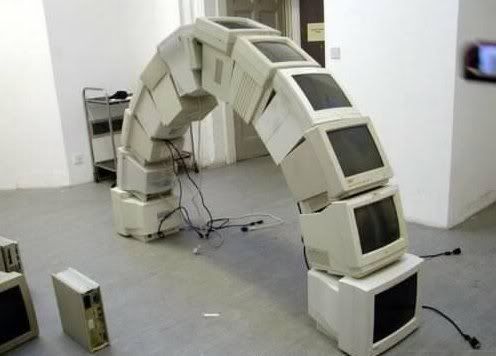
As you can see, the whole thing would collapse in an instant if gravity wasn't pulling down on every block. Or in this case, on every computer monitor. It relies on shaping every block exactly for its position. The topmost block (monitor) is hugely important and is called the keystone. It's really very clever. The downside is nothing can stay up until everything's in place. So they'd build wooden supports beneath and then knock them away after the keystone was in.
The one thing both Greek and Roman architecture have in common is they both use gravity as glue.
A change is as good as a holiday
I've given the blog its first makeover in more than a year, in honour of The Ionia Sanction releasing tomorrow. (Tomorrow! OMG!)
If you'd been watching, you'd have seen the background texture, colour, intensity, and brightness, and the header text and the picture of Nico and Diotima change about every 30 seconds for the last four hours as I struggled to get everything bedded in. Sorry about that.
I think we're more or less stable now, but do please let me know if anything isn't working for you.
Next up, Ionia Sanction gets its very own page tab, and I remember when it was only a few lines of text on my PC. How the time flies.
You too can be a porn site!
The people who control the internet have decided, in their near-infinite wisdom, to create a new domain type. This one is .XXX, and there's no prize for guessing what that refers to.
As we all know, porn sites like to hijack well known names. I'll never forget the day that I decided, while doing a technology demonstration in front of hundreds of people, to use the Office of the US President for my example. I typed whitehouse.com by reflex, instead of the somewhat more correct whitehouse.gov. It turned out that whitehouse.com was a porn site, as I and the hundreds of men and women watching soon discovered. I apologize (again) to everyone who was there.
So, name hijacking on the new .XXX domains is an obvious problem. To counter this, the Gnomes of the Net have declared a sunrise period of 52 days, which began yesterday, September 7, during which people can block use of their brand names.
And there's the rub. They're only allowing you to block use of your name if it's a registered trademark. If you're Microsoft, you can prevent a porn site using microsoft.xxx. Although that would be ironic since micro and soft probably aren't at the forefront of desirable concepts when you're looking for porn. But if, however, you want to block GaryCorby.xxx, just to pick a random example, then you can't do it.
I'm fairly sure the Gnomes haven't thought this through. Maybe Hollywood celebrities trademark their names, but the vast majority of people who might get googled from time to time don't. A porn site could register hundreds of mid-grade names and point them to the same salacious location.
So I'm stuck. And so are you, if you want to block your name.
IP addresses: the fingerprints of the internet
You may have noticed a sensational real-life case recently in which an 18 year old girl in Sydney had a bomb hung around her neck. The bomb proved to be an extortion hoax, but they didn't know that for the first 10 hours while they worked out how to get the thing off her, in fear of an anti-tamper trigger. Which means the girl had to sit still for 10 hours, not knowing if she was going to die at any moment. (I presume the policewoman who volunteered to sit with her is due a huge medal.) A man's been arrested for it, in, of all places, Kentucky. Since Kentucky is somewhat outside Australian police jurisdiction, the FBI did the honours on their behalf.
The extortion note said to contact a certain email address: dirkstraun1840@gmail.com. I guess the extortionist is a James Clavell fan. It's nice to know even heartless extortionists can be readers.
So, now we start detecting...
Keep in mind that the extortionist had to access that gmail account to see if his victims had replied.
Every machine connected to the internet has assigned a unique number called its IP address. If you think of it as being like a telephone number, you'd not be far wrong.
The IP numbers have to be unique, because these things are what the internet uses to send messages to the right place. Imagine if two people had exactly the same phone number; it's the same logic. The machine you're using to read this blog has a unique IP address.
IP addresses are always broken into four parts, written as A.B.C.D, purely to make them easier to manage. Each of A, B, C and D is a number from 0 to 255. So, for example, the site FBI.gov, has an IP address of 209.251.178.99.
It should come as no surprise that Google logs the IP address of everyone who uses its email accounts.
So the Australian police called Google and asked, who had accessed that email account. Google replied with three IP addresses, and the dates and times of access.
The first IP address had been assigned to an internet kiosk at O'Hare airport in Chicago. The email account had been set up from that kiosk, before the crime occurred. Of course they didn't know who had used the kiosk, but they knew for sure the extortionist had been at O'Hare at that date and time.
The second IP address had been assigned to a computer at a public library at Kincumber, on the central coast of New South Wales. Incidentally, this is close to where my mother lives, but I don't suspect her.
The third IP address had been assigned to an internet kiosk at a video store not far from the library.
The second and third access had been to see if there was any mail. And they were accessed after the crime.
Clearly the extortionist had flown from Chicago to Sydney, committed the crime, and then gone north to Kincumber, and the police knew dates, times and places of where he'd been. This, plus travel records and some video camera footage from the locations was enough to find their suspect.
How did they know where to find the computers with those IP addresses? Since every number must be unique, a central authority called ICANN allocates them. ICANN, through third parties, allocates them in blocks. A small ISP might ask for a block of IP addresses for its customers to use, and be allocated for example every address that begins 10.20.30. That's called a class C block because the A, B and C parts of the addresses are all the same, and only the D part varies. (Remember I said IP addresses are always written in four parts? This is why.) The ISP in this example has available to allocate every number from 10.20.30.000 to 10.20.30.255.
ISPs, in turn, keep a record of which of their customers have been assigned which numbers.
When the police got the three IP addresses from Google, they could immediately look up which ISPs owned the blocks in which those numbers sat. They then had to get from the ISPs which computers had those numbers assigned at that particular time.
So in summary, the web site owner can tell the police the IP address of the criminal. ICANN tells the police which ISP controls that address, and the ISP tells the police precisely which computer was using the address at the moment of the crime.
IP addresses are, therefore, very much like fingerprints on the internet.
I want to talk about the trail that led to the arrest, because it's an interesting example of detection in an internet world.
So, now we start detecting...
Keep in mind that the extortionist had to access that gmail account to see if his victims had replied.
Every machine connected to the internet has assigned a unique number called its IP address. If you think of it as being like a telephone number, you'd not be far wrong.
The IP numbers have to be unique, because these things are what the internet uses to send messages to the right place. Imagine if two people had exactly the same phone number; it's the same logic. The machine you're using to read this blog has a unique IP address.
IP addresses are always broken into four parts, written as A.B.C.D, purely to make them easier to manage. Each of A, B, C and D is a number from 0 to 255. So, for example, the site FBI.gov, has an IP address of 209.251.178.99.
It should come as no surprise that Google logs the IP address of everyone who uses its email accounts.
So the Australian police called Google and asked, who had accessed that email account. Google replied with three IP addresses, and the dates and times of access.
The first IP address had been assigned to an internet kiosk at O'Hare airport in Chicago. The email account had been set up from that kiosk, before the crime occurred. Of course they didn't know who had used the kiosk, but they knew for sure the extortionist had been at O'Hare at that date and time.
The second IP address had been assigned to a computer at a public library at Kincumber, on the central coast of New South Wales. Incidentally, this is close to where my mother lives, but I don't suspect her.
The third IP address had been assigned to an internet kiosk at a video store not far from the library.
The second and third access had been to see if there was any mail. And they were accessed after the crime.
Clearly the extortionist had flown from Chicago to Sydney, committed the crime, and then gone north to Kincumber, and the police knew dates, times and places of where he'd been. This, plus travel records and some video camera footage from the locations was enough to find their suspect.
How did they know where to find the computers with those IP addresses? Since every number must be unique, a central authority called ICANN allocates them. ICANN, through third parties, allocates them in blocks. A small ISP might ask for a block of IP addresses for its customers to use, and be allocated for example every address that begins 10.20.30. That's called a class C block because the A, B and C parts of the addresses are all the same, and only the D part varies. (Remember I said IP addresses are always written in four parts? This is why.) The ISP in this example has available to allocate every number from 10.20.30.000 to 10.20.30.255.
ISPs, in turn, keep a record of which of their customers have been assigned which numbers.
When the police got the three IP addresses from Google, they could immediately look up which ISPs owned the blocks in which those numbers sat. They then had to get from the ISPs which computers had those numbers assigned at that particular time.
So in summary, the web site owner can tell the police the IP address of the criminal. ICANN tells the police which ISP controls that address, and the ISP tells the police precisely which computer was using the address at the moment of the crime.
IP addresses are, therefore, very much like fingerprints on the internet.
Attack of the cupcakes
Proving yet again that British Intelligence have the coolest spies in the world, the Daily Telegraph in London reports that MI6 and GCHQ have hacked into an al-Qaeda web site, and replaced instructions on how to build a bomb with a recipe for cupcakes.
If I put something like that in a book, people would tell me to take it out because it was too unbelievable. The truth is, reality is frequently stranger than fiction, but the sad fact is that fiction has to be believable, whereas reality operates under no such restriction.
If I put something like that in a book, people would tell me to take it out because it was too unbelievable. The truth is, reality is frequently stranger than fiction, but the sad fact is that fiction has to be believable, whereas reality operates under no such restriction.
Top marks for the cutest cyber attack in history.
Why you shouldn't trust information on web sites (including this one)
I've previously ranted about the disaster that is Wikipedia for anything more complex than pop culture. Disaster if you want correct information, that is. It's terrific if you'll be happy with something that merely sounds right.
Today I'd like to point out something from an entirely different site. I noticed this as I was doing some book research for the fourth in my series. I won't embarrass the site by naming it. I'll merely repeat the embarrassing bit.
Our subject is a short biography of Callias, who if you've read The Pericles Commission you'll know appears as a character. He was the richest man in Athens and their chief diplomat. Here's what the rather authoritative-looking web site says:
One short bio has confused three different men. What's probably happened here is whoever wrote this wrong bio did a Google search across "Callias" and "Athens" and just assumed it was the same Callias every time. Then they repeated it all as fact for hapless schoolchildren to copy and paste into their essays. I hope the teachers catch it.
Today I'd like to point out something from an entirely different site. I noticed this as I was doing some book research for the fourth in my series. I won't embarrass the site by naming it. I'll merely repeat the embarrassing bit.
Our subject is a short biography of Callias, who if you've read The Pericles Commission you'll know appears as a character. He was the richest man in Athens and their chief diplomat. Here's what the rather authoritative-looking web site says:
Callias was a diplomat and a notable member of one of the wealthiest families of ancient Athens, as well as an Athenian leader.Correct!
He was a general of the Peloponnesian War.Er...no. There was a Callias who was a strategos (General), but it was a different Callias. It was a relatively common name. The wealthy diplomat was Callias son of Hipponicus. The military leader was Callias son of Calliades.
He distinguished himself at the battle of Marathon (490 B.C.)Very true! (Note the date in parentheses)
In his old age Callias was one of the ambassadors sent to Sparta with Callistratus to negotiate a peace treaty in 371 BC.In his old age indeed. He must have been at least 137 years old by this date, considering he fought at Marathon. The Callias here is the grandson of the one they started with. I mentioned in a previous post that the Greeks almost always named the firstborn son after the paternal grandfather. That's a trap for new players, for anyone writing about ancient Greece.
One short bio has confused three different men. What's probably happened here is whoever wrote this wrong bio did a Google search across "Callias" and "Athens" and just assumed it was the same Callias every time. Then they repeated it all as fact for hapless schoolchildren to copy and paste into their essays. I hope the teachers catch it.
My advice for anyone researching ancient Greeks:
- When you find a reference, always ask yourself, "Is this the guy I want? Could it be his grandson? Could it be his grandfather?"
- Always check the "son of" value! It's like a surname.
Spaced out
Some time ago I wrote about advanced searching with Word, and also, advanced use of replace. Here's another one: a quick way to remove extra spaces. If you're like me, you occasionally put three spaces after a full stop (that's a period for US readers), or simply hit the space bar twice in the middle of a sentence. You can go blind searching by eye for extra white space on the screen, so save your eyesight and let the computer do it for you.
Run the Find/Replace dialog in Word. That's cntrl-f on the keyboard or Edit --> Find on the menu bar.
The string you're searching for is this:
I've inverted the the colours and made it large so you can see there are two spaces at the end of the search string. You must include those two spaces in the search, or this won't work. Make sure you click the More button and then check the Use wildcards checkbox. Here's a screenshot:

If you don't care about the technicalities, you can stop reading now and just use the search as I described. Otherwise, here's how it works.
The two spaces at the end of the string will match any two spaces in your manuscript.
The problem is we want to catch two spaces in the middle of sentences, but two spaces is always correct when a sentence ends and a new one begins. We have to exclude the start of sentences; that's what the gobbledygook does.
Everything inside the square brackets [ ... ] will match a single character. The exclamation mark ! right at the start means match any one character except those that follow. A sentence could end in a full-stop (that's the \.), an exclamation mark (that's the \!), or a question mark (\?). We have to deal with the situation where a sentence ends with dialogue, in which case the final character is a speech mark (\"). We also don't care if the spaces trail the end of a paragraph (that's the ^l). The backslash character \ before the punctuation in each case is merely an instruction to Word to treat the following character as a literal, because each of those characters has a special meaning when wildcards are turned on. The \ escapes the special meaning. The ^l is a special symbol that denotes the end of a paragraph (actually, any manual line break).
So three spaces will be caught anywhere. Two spaces will be ignored if they're preceded by standard end-of-sentence punctuation. Two spaces preceded any other character will be caught, because the square brackets will match anything except the end of a sentence.
Run the Find/Replace dialog in Word. That's cntrl-f on the keyboard or Edit --> Find on the menu bar.
The string you're searching for is this:
[!\!\.\"\?^l]
I've inverted the the colours and made it large so you can see there are two spaces at the end of the search string. You must include those two spaces in the search, or this won't work. Make sure you click the More button and then check the Use wildcards checkbox. Here's a screenshot:

If you don't care about the technicalities, you can stop reading now and just use the search as I described. Otherwise, here's how it works.
The two spaces at the end of the string will match any two spaces in your manuscript.
The problem is we want to catch two spaces in the middle of sentences, but two spaces is always correct when a sentence ends and a new one begins. We have to exclude the start of sentences; that's what the gobbledygook does.
Everything inside the square brackets [ ... ] will match a single character. The exclamation mark ! right at the start means match any one character except those that follow. A sentence could end in a full-stop (that's the \.), an exclamation mark (that's the \!), or a question mark (\?). We have to deal with the situation where a sentence ends with dialogue, in which case the final character is a speech mark (\"). We also don't care if the spaces trail the end of a paragraph (that's the ^l). The backslash character \ before the punctuation in each case is merely an instruction to Word to treat the following character as a literal, because each of those characters has a special meaning when wildcards are turned on. The \ escapes the special meaning. The ^l is a special symbol that denotes the end of a paragraph (actually, any manual line break).
So three spaces will be caught anywhere. Two spaces will be ignored if they're preceded by standard end-of-sentence punctuation. Two spaces preceded any other character will be caught, because the square brackets will match anything except the end of a sentence.
Blog stats: 2010
There seems to be a tradition around of mentioning some blog stats at the end of the year. So herewith are the basic numbers for this humble blog in 2010:
Total hits: 44,829
That number excludes my own hits. It's real readers only.
Individual readers: 35,007
There'll be some duplication there from regular readers who use multiple IP addresses, but the true number is clearly well in excess of 34,000. Most of those people came in via external link recommendations, not, to my surprise, from google searches.
Most hits on a single day: 852
That was the post on how to use the autocorrect feature in Word, which stunned me with its popularity. Is Word really that interesting? People still hit it heavily to this day.
Average hits per day, every day, over the entire year: 123
Average unique readers per day: 96
Number of posts: 147
One every three days. I'm such a slacker.
So that's it for the stats that are Gary-specific. Now for some general technology stats that fascinated me.
Most popular incoming search engine: Google at 98%+
Next is Yahoo at 1%, then Ask. If I were the product manager for Microsoft bing, I'd slit my wrists now.
Most popular browsers: Firefox (43%), IE (23%), Chrome (15%), Safari (8%)
IE is dramatically down, but that's no surprise given the rise of excellent alternatives. I started using Chrome in 2010 once AdBlock became available for it. I'm a bit surprised Chrome adoption isn't higher.
And here comes what for me is the stunner. Most popular operating system:
30.80% MacOSX
24.60% WinXP
18.60% WinVista
18.00% Win7
2.80% Linux
For the first time in history, MacOS beats out Windows on a per-version basis. Granted the total Windows is 60% of home machines, but that is still a massive degradation. It's not hard to work out where to point the finger: Vista is the Worst Operating System Ever. I'm amazed 18% of people still use it.
25% cling to XP to avoid Vista. My guess is many of those that had to shift off XP, probably due to forced hardware replacement, obviously decided that they might as well go to the Mac to avoid Vista.
BillG used to talk about "betting the company" on each new release of Windows. With Vista, they might finally have lost. That only 18% are on Windows 7 has to be depressing my friends in Redmond. They desperately need to convert that into 60% on Windows 7, and then start clawing back the lost users.
Giggles the netbook
Two weeks ago I acquired a netbook for travel. I face a few weeks on the road, and a light device that's good for email, web and writing will be just the thing. So I bought an Asus Eee PC, model 1001P.
The iPad was very tempting, but unfortunately, although it looks way cool, at heart it's a toy. Try typing on it, or connecting a USB. Or multitasking. The iPad is however streets ahead of everything else as an eReader. I much prefer the high quality backlit screen of the iPad to any of the eInk systems, and I never thought I'd find myself saying that. If only someone could marry Apple's product management to Microsoft's engineering, it would be awesome.
So I got the Eee PC, and my girls instantly named the machine Giggles. Forthwith is Gary's evaluation of Giggles.
First, the good news:
The battery life is incredible at 9 hours or more. Who would have thought advertising could tell the truth?
The small keyboard's not as much of an impediment as I expected. If like me you can touch type then you'll hit a lot of wrong keys, but it can be got used to with a lot of practise. Ditto, the mousepad is small but usable.
Connectivity is surprisingly good. (and far better than that iPad I mentioned…)
I expected a restrictive 10.1" screen size and therefore was not disappointed. It's usable for writing.
The portability is excellent. I carry Giggles to places where I used to take pen and paper.
It's so cheap, it's like buying a disposable computer. Value for money is A+.
Now for the bad news. Considering what I paid for it, it's rude to complain, but that won't stop me:
The Intel graphics chip is awful. Giggles is happiest at 1024x600 with no external monitor. Giggles can drive an external monitor—even my 24" monitor in portrait mode—but don't expect to look at it too long without getting eyestrain or a headache. There is a weird problem which I haven't worked out yet with viewing video from disk files—audio works but video is nothing but black—though streamed video from the net works fine.
You can practically see the steam-driven cogs make the CPU tick over. Sometimes I type text, and a few seconds later the machine catches up. No one in their right mind would run Vista or Win 7 on this box. XP's the strained limit. It might actually make a reasonably undemanding linux platform.
Asus includes a whole pile of "helpful" system utilities. These silently take over from standard Windows control panel dialogs, so that things don't behave like they should. For example, you can set screen resolution through the standard dialog all you like; and it won't do a thing because Asus has pre-installed a service called astray that sets the resolution to 800x600. You can see the resolution change from your own settings on boot as soon as astray starts. It took me two days to realize how much my life would improve if I hunted own and removed all the "helpful" utilities. Vanilla XP works just fine.
All in all, very usable as a takeaway machine. I might even manage to write while I'm away.
Subscribe to:
Posts (Atom)