These days we think of becoming an
adult as a gradual process, but to the Greeks it was an instantaneous event. Though it worked differently for boys and girls.
In the case of a well-born Athenian girl, she would go to a girls' school at the Sanctuary of Brauron, a year or two before marriageable age. Less privileged girls would get their education at home.
Either way, at the end of their time the girls would perform a ceremony in which they dedicated their toys to the goddess Artemis. From that instant they became marriageable adults.
Proud fathers would commission a
statue of their girl to commemorate the occasion. This was like the graduation photos that
families take these days, only back in classical Athens the graduation photo was done in solid
marble.
The great majority of statues of
girls from the ancient world come from that sanctuary. The surviving statues are very beautiful and lifelike, so that we have
an astonishingly good idea what the girl children of classical Athens looked
like.
On the morning of that ceremonial day, the girl was still a girl. By nightfall, she was a young lady. This instant graduation system might seem tough
on the girls, but oddly the boys had the exact opposite problem.
Every male went into the army at the age of eighteen and returned to civilian life at twenty. This two year compulsory service system was still in use across Europe only a few decades ago. As soon as he reached eighteen the Athenian man could vote in the assembly, but...he didn’t obtain his legal majority until his father had passed away. It was possible for even a forty year old man to still be a legal child.
This had the odd effect that many young women who were legal adults were married to men older than themselves who were legal children!

Showing posts with label Athens. Show all posts
Showing posts with label Athens. Show all posts

The Polemarch lives in the Epilyceum
The Polemarch was one of three senior archons who ran classical Athens. The job title means war leader, but by the time of my stories his job had changed to being mayor of all the resident aliens in the city, of which there were many. The resident aliens were a big part of the economy.
Like all archon jobs, people got elected Polemarch for a year, and having done the job once you could never be elected to it again. Also, if you won the election, you moved home.
The Polemarch had an official residence, called the Epilyceum. (I'm using the latin form of the name here. The exact transliteration is Epilykaion.)
Aristotle says that the Polemarch's official residence used to be called the Polemarcheum, but the name changed after one man who held the job, a fellow named Epilycos, totally renovated the place out of his own pocket. Which was rather clever of him because now he'll be remembered forever. Though I imagine his real motive was along the lines of his wife saying, "I'm not living in that horrible, drafty, run-down place until you fix it up!"
Some modern historians reject Aristotle on the grounds that epilyceum in Greek means "outside the Lyceum". Since there happened to be a place called the Lyceum, they take it to mean the Polemarch's residence was next door.
It sounds reasonable, but the problem is they're guessing from a distance of 2,600 years, while Aristotle was passing on what was probably common belief a hundred or so years after the fact. They can't argue that the name is odd. There was a comedian called Epilycos, so an archon by that name is perfectly possible.
So now you can say to people at parties that the Polemarch lived in the Epilyceum.
Like all archon jobs, people got elected Polemarch for a year, and having done the job once you could never be elected to it again. Also, if you won the election, you moved home.
The Polemarch had an official residence, called the Epilyceum. (I'm using the latin form of the name here. The exact transliteration is Epilykaion.)
Aristotle says that the Polemarch's official residence used to be called the Polemarcheum, but the name changed after one man who held the job, a fellow named Epilycos, totally renovated the place out of his own pocket. Which was rather clever of him because now he'll be remembered forever. Though I imagine his real motive was along the lines of his wife saying, "I'm not living in that horrible, drafty, run-down place until you fix it up!"
Some modern historians reject Aristotle on the grounds that epilyceum in Greek means "outside the Lyceum". Since there happened to be a place called the Lyceum, they take it to mean the Polemarch's residence was next door.
It sounds reasonable, but the problem is they're guessing from a distance of 2,600 years, while Aristotle was passing on what was probably common belief a hundred or so years after the fact. They can't argue that the name is odd. There was a comedian called Epilycos, so an archon by that name is perfectly possible.
So now you can say to people at parties that the Polemarch lived in the Epilyceum.
The Battle of Marathon
There are two astonishing ratios about the Battle of Marathon.
There were almost exactly 11,000 Greeks: that's 1,000 men from each of the tribes of Athens, and 1,000 men from nearby Plataea.
The Persians used 600 boats to ferry in troops. The actual number of troops is unknown, but for that number of transport craft it comes to between 30,000 and 100,000 Persians, including a few thousand cavalry.
So the first ratio is that the Greeks were outnumbered somewhere between 3:1 to 9:1, depending what assumptions you want to make about Persian transports.
The next ratio is known with great precision:
203 Greek dead.
6,400 Persian dead.
That's 32 Persian dead for every Greek who fell.
Which isn't bad going when you're not just outnumbered, but also you're the attacking side.
The casualty numbers are known because the Greeks set up a memorial that listed all their fallen. The Persian numbers are known because before the battle the Greeks had promised to the Gods to sacrifice a goat for every enemy they killed. They counted the Persian dead carefully and then discovered they'd killed so many enemies that they couldn't find enough goats. They paid off their debt to the Gods on a yearly instalment plan that took thirteen years to complete.
Despite its vast importance, there's very little agreement about what actually happened. Modern historians can’t even agree on which direction the opposing lines faced, let alone details like whether the Persian cavalry took the field.
One theory goes that the Persians were aligned with their backs to the sea, and the Greeks attacked from inland. Like so:
I just can't credit this. As you can see the plain of Marathon forms a rectangle that runs lengthways along the coast, ringed by mountains to landward. The Greeks would have to be insane to place their grossly outnumbered troops where they could be easily outflanked by the numerically superior Persians. Also this alignment puts their left flank in easy reach of the Persian cavalry.
I'm pretty sure if you gave this problem to any modern military commander, he would instantly place his outnumbered Greeks so that they had to span the shortest possible line. Which would be like this:
This map comes from the excellent The Battle of Marathon by Peter Krentz. My copy's sitting by my left elbow as I write this.
You'll notice there's solid land in the top right of one map and a small bay in the other. Most maps put a marsh there. In fact the Greek coastline changes constantly and all three options have been on that spot at one time or another. Nobody really knows what was there when the battle was fought.
The Greeks made the decision to take the fight to the enemy. Each soldier lightened his battle load as much as possible the night before and then they marched out at first light.
The next big point of contention is that Herodotus states, very clearly, that the Greeks marched to within 8 stadia of the enemy, and then they ran in the rest of the way under a hail of arrows.
At the ancient Olympics there was an event in which the competitors ran two lengths of the stadium — two stadia — in soldier’s kit. The men of Marathon ran four times that distance, knowing that at the end they would have to fight for their lives against an enemy many times more numerous.
A lot of modern historians discount that story out of hand, on the grounds that heavy infantry can't run almost a mile and then fight.
The problem is, that the ancient sources are absolutely unanimous that that's what happened. Every written source, every sculptural relief , gives the same picture. And Herodotus, who is often vague on numbers, is absolutely precise on this one. Herodotus also goes out of his way to make the point that everyone dropped as much load as they could, even shedding armour so they could move fast.
Why did they have to run? I think the reason was the Persian cavalry, who could have torn the Greeks apart. Herodotus says the cavalry was there, but once the battle begins he never mentions them. I think the reason is that the Greek plan was to engage the enemy line before the enemy cavalry had time to deploy. With the mountains on one side and the sea on the other, it meant that once the infantry engaged the mounted troops were bottled up behind their own line.
The fact is that modern elite troops could make that run. The counter-argument is that the citizen militia of Athens weren't professional soldiers. Which is true. But what is also true is that we're talking about the most successful citizen army in all history, and those guys in the line knew with utter certainty that they wouldn't live to midday if they didn't cross the field in time.
There were almost exactly 11,000 Greeks: that's 1,000 men from each of the tribes of Athens, and 1,000 men from nearby Plataea.
The Persians used 600 boats to ferry in troops. The actual number of troops is unknown, but for that number of transport craft it comes to between 30,000 and 100,000 Persians, including a few thousand cavalry.
So the first ratio is that the Greeks were outnumbered somewhere between 3:1 to 9:1, depending what assumptions you want to make about Persian transports.
The next ratio is known with great precision:
203 Greek dead.
6,400 Persian dead.
That's 32 Persian dead for every Greek who fell.
Which isn't bad going when you're not just outnumbered, but also you're the attacking side.
The casualty numbers are known because the Greeks set up a memorial that listed all their fallen. The Persian numbers are known because before the battle the Greeks had promised to the Gods to sacrifice a goat for every enemy they killed. They counted the Persian dead carefully and then discovered they'd killed so many enemies that they couldn't find enough goats. They paid off their debt to the Gods on a yearly instalment plan that took thirteen years to complete.
Despite its vast importance, there's very little agreement about what actually happened. Modern historians can’t even agree on which direction the opposing lines faced, let alone details like whether the Persian cavalry took the field.
One theory goes that the Persians were aligned with their backs to the sea, and the Greeks attacked from inland. Like so:
 |
| Wrong |
I'm pretty sure if you gave this problem to any modern military commander, he would instantly place his outnumbered Greeks so that they had to span the shortest possible line. Which would be like this:
 |
| Right. From The Battle of Marathon by Peter Krentz |
You'll notice there's solid land in the top right of one map and a small bay in the other. Most maps put a marsh there. In fact the Greek coastline changes constantly and all three options have been on that spot at one time or another. Nobody really knows what was there when the battle was fought.
The Greeks made the decision to take the fight to the enemy. Each soldier lightened his battle load as much as possible the night before and then they marched out at first light.
The next big point of contention is that Herodotus states, very clearly, that the Greeks marched to within 8 stadia of the enemy, and then they ran in the rest of the way under a hail of arrows.
At the ancient Olympics there was an event in which the competitors ran two lengths of the stadium — two stadia — in soldier’s kit. The men of Marathon ran four times that distance, knowing that at the end they would have to fight for their lives against an enemy many times more numerous.
A lot of modern historians discount that story out of hand, on the grounds that heavy infantry can't run almost a mile and then fight.
The problem is, that the ancient sources are absolutely unanimous that that's what happened. Every written source, every sculptural relief , gives the same picture. And Herodotus, who is often vague on numbers, is absolutely precise on this one. Herodotus also goes out of his way to make the point that everyone dropped as much load as they could, even shedding armour so they could move fast.
Why did they have to run? I think the reason was the Persian cavalry, who could have torn the Greeks apart. Herodotus says the cavalry was there, but once the battle begins he never mentions them. I think the reason is that the Greek plan was to engage the enemy line before the enemy cavalry had time to deploy. With the mountains on one side and the sea on the other, it meant that once the infantry engaged the mounted troops were bottled up behind their own line.
The fact is that modern elite troops could make that run. The counter-argument is that the citizen militia of Athens weren't professional soldiers. Which is true. But what is also true is that we're talking about the most successful citizen army in all history, and those guys in the line knew with utter certainty that they wouldn't live to midday if they didn't cross the field in time.
Ancient Greek toilets
There was no such thing as a flushing toilet in Ancient Greece. Remarkably, there was a flushing toilet 1,200 years before that, at the Palace of Knossos, in Minoan times, and it's the oldest known flushing toilet in Europe. It probably worked by having a slave pour buckets of water into the drain.
But in Classical times, when Nico and Diotima are at work, they had no plumbing into the home. All water was carried in from public fountains, and that was intended for drinking and washing. If you needed to go to the toilet, well, that was what the chamber pot was for.
If you lived in the city, then the bad news was that there was no garbage collection service. There was however a drain that ran down the middle of every street. That's where the contents of the chamber pot went. I've made use of this fun fact without any mercy for Nico. Whenever he gets knocked down in a street fight, he invariably goes straight into that drain.
In fact we can be quite certain that's where the waste went, because eventually the Athenians passed a law forbidding citizens to dump their waste in the street. The same law created the world's first public landfill site outside the city walls (another first for Athens!) and required all rubbish to be dumped no closer than that. However this all happened in 400BC, sixty years too late to save Nico from going into the poo.
Now as to the delicate problem of a world without toilet paper...you won't be surprised to hear that this is not a well-documented subject. The Romans famously used a sponge tied to the end of a stick. The Greeks might have used a sponge too, when one came to hand. But there's evidence to suggest that a handful of clay was more common. An interesting alternative was the leaves of vegetables such as leeks.
I must mention in passing that in the absence of washing powder, the next best thing to keep your clothes clean is urine. (It's acidic.) They actually had collection jars to store it in.
But in Classical times, when Nico and Diotima are at work, they had no plumbing into the home. All water was carried in from public fountains, and that was intended for drinking and washing. If you needed to go to the toilet, well, that was what the chamber pot was for.
If you lived in the city, then the bad news was that there was no garbage collection service. There was however a drain that ran down the middle of every street. That's where the contents of the chamber pot went. I've made use of this fun fact without any mercy for Nico. Whenever he gets knocked down in a street fight, he invariably goes straight into that drain.
In fact we can be quite certain that's where the waste went, because eventually the Athenians passed a law forbidding citizens to dump their waste in the street. The same law created the world's first public landfill site outside the city walls (another first for Athens!) and required all rubbish to be dumped no closer than that. However this all happened in 400BC, sixty years too late to save Nico from going into the poo.
Now as to the delicate problem of a world without toilet paper...you won't be surprised to hear that this is not a well-documented subject. The Romans famously used a sponge tied to the end of a stick. The Greeks might have used a sponge too, when one came to hand. But there's evidence to suggest that a handful of clay was more common. An interesting alternative was the leaves of vegetables such as leeks.
I must mention in passing that in the absence of washing powder, the next best thing to keep your clothes clean is urine. (It's acidic.) They actually had collection jars to store it in.
Elections and Luck
With elections coming up for our friends in the US, here's a quick description of how you'd be voting if we were all back in ancient Athens.
Every election was a combination of vote and lottery. The Athenians fiddled with the voting system constantly. They'd only just invented democracy after all, and they weren't afraid to experiment to see what worked best. But the system always had the same basic elements. It went something like this:
Note the lottery system. It guaranteed that, unlike modern systems, everyone had an equal chance of one day holding office, and that serial power-seekers hadn't a hope.
If you'd asked an ancient Athenian, they would have told you, in all seriousness, that the lottery system was an essential part of any democracy, and that any state that didn't have a luck element wasn't a true democracy. Plato's quite famous for saying that anyone who wants power, shouldn't have it. But that was actually the default Athenian view.
Every election was a combination of vote and lottery. The Athenians fiddled with the voting system constantly. They'd only just invented democracy after all, and they weren't afraid to experiment to see what worked best. But the system always had the same basic elements. It went something like this:
- Each of the ten tribes took it in turn to supply candidates. (So that each tribe supplied officials once every ten years.)
- The tribe whose turn it was selected candidates for all the elected positions. The candidates were selected by lottery from across the tribe.
- All the citizens of Athens then voted from among the randomly-selected candidates for who they thought would do the best job.
Note the lottery system. It guaranteed that, unlike modern systems, everyone had an equal chance of one day holding office, and that serial power-seekers hadn't a hope.
If you'd asked an ancient Athenian, they would have told you, in all seriousness, that the lottery system was an essential part of any democracy, and that any state that didn't have a luck element wasn't a true democracy. Plato's quite famous for saying that anyone who wants power, shouldn't have it. But that was actually the default Athenian view.
The Athenian army
So, having correctly guessed the Higgs announcement, I'll revert to normal. Let's talk about the army.
If you were a guy in classical Athens, and your father was a citizen, then when you turned 18 you joined the army. No exceptions. You were in for 2 years, which was boot camp. Boots were known as ephebes. Nico protests on several occasions in the books that he's done his time as an ephebe. That's his way of saying he's paid his dues and though he might look young, he's a for-real citizen of Athens with all the rights and privileges that implies.
Athens had its equivalent of the stereotypical boot camp sergeant. The ephebes were grouped by their tribe membership, and each group had in charge of them a man over forty years of age; someone who was voted by the citizenry to be a fine, upstanding examplar to the lads, and likely to instill the necessary virtues. Which meant he was really, really tough.
Ephebe training was as much about instilling moral character as toughening you up and teaching you how to fight in a phalanx. After the first year, you were given a spear and shield by the state and swore an oath.
It seems the ephebes spent a lot of time on guard duty. They also patrolled the countryside. I suspect phalanx training was drilled mercilessly, because the last thing you need in a battle is some idiot pointing his spear the wrong way.
Phalanxes work like this: there are three rows (probably). The younger men at the front, then the middle-aged, then the old men at back. The phalanx is a very dense rectangle of men. There's no such thing as individual combat. When properly lined up, a man has his spear in his right hand (tough luck for the lefties). He has his huge, round hoplon shield on his left arm. The shield covers the left half of his own body, plus the right half of his left-hand neighbour's body. His right-hand neighbour's shield in turn covers his right half. This overlap is a natural consequence of everyone holding a big shield in their left hand, but stop and think about it for a moment, so you'll see what happens next...
When a phalanx charges at the enemy, it runs on an ever-increasing angle to the right. Why? Because everyone depends on their right-hand neighbour for some of their shield protection. Everyone wants to nudge themselves a little more behind their neighbour's shield, and the neighbour is busy doing the same.
Generals know this will happen and have a fair idea how much drift there'll be. They position the units to account for it.
It's not such a bad idea anyway, because although there's a lovely row of shields down your left flank, down your right flank there's absolutely nothing but exposed right arms. This is why the right hand side of the line is considered the position of honour. You only put your best soldiers there. If your right flank gets enveloped, it's going to be a bad day.
Once contact is made, the whole thing turns into a pushing match. Think rugby scrum with sharp implements and you're probably fairly close. The idea is to break the enemy line, not kill the individuals. Once a line is broken, the soldiers are utterly exposed without their shield wall and will typically run.
Warfare is normally a citizen-only exercise, but interestingly, the Battle of Marathon is believed to be the first battle in history in which the slaves fought alongside their masters.
If you were a guy in classical Athens, and your father was a citizen, then when you turned 18 you joined the army. No exceptions. You were in for 2 years, which was boot camp. Boots were known as ephebes. Nico protests on several occasions in the books that he's done his time as an ephebe. That's his way of saying he's paid his dues and though he might look young, he's a for-real citizen of Athens with all the rights and privileges that implies.
Athens had its equivalent of the stereotypical boot camp sergeant. The ephebes were grouped by their tribe membership, and each group had in charge of them a man over forty years of age; someone who was voted by the citizenry to be a fine, upstanding examplar to the lads, and likely to instill the necessary virtues. Which meant he was really, really tough.
Ephebe training was as much about instilling moral character as toughening you up and teaching you how to fight in a phalanx. After the first year, you were given a spear and shield by the state and swore an oath.
It seems the ephebes spent a lot of time on guard duty. They also patrolled the countryside. I suspect phalanx training was drilled mercilessly, because the last thing you need in a battle is some idiot pointing his spear the wrong way.
Phalanxes work like this: there are three rows (probably). The younger men at the front, then the middle-aged, then the old men at back. The phalanx is a very dense rectangle of men. There's no such thing as individual combat. When properly lined up, a man has his spear in his right hand (tough luck for the lefties). He has his huge, round hoplon shield on his left arm. The shield covers the left half of his own body, plus the right half of his left-hand neighbour's body. His right-hand neighbour's shield in turn covers his right half. This overlap is a natural consequence of everyone holding a big shield in their left hand, but stop and think about it for a moment, so you'll see what happens next...
When a phalanx charges at the enemy, it runs on an ever-increasing angle to the right. Why? Because everyone depends on their right-hand neighbour for some of their shield protection. Everyone wants to nudge themselves a little more behind their neighbour's shield, and the neighbour is busy doing the same.
Generals know this will happen and have a fair idea how much drift there'll be. They position the units to account for it.
It's not such a bad idea anyway, because although there's a lovely row of shields down your left flank, down your right flank there's absolutely nothing but exposed right arms. This is why the right hand side of the line is considered the position of honour. You only put your best soldiers there. If your right flank gets enveloped, it's going to be a bad day.
Once contact is made, the whole thing turns into a pushing match. Think rugby scrum with sharp implements and you're probably fairly close. The idea is to break the enemy line, not kill the individuals. Once a line is broken, the soldiers are utterly exposed without their shield wall and will typically run.
Warfare is normally a citizen-only exercise, but interestingly, the Battle of Marathon is believed to be the first battle in history in which the slaves fought alongside their masters.
ORBIS: your route planner for the ancient world
Ancient mystery authors rejoice! Stanford University has produced an online trip planner: one for getting you around the ancient Roman Empire. It comes complete with route planning, schedule estimates and fare costs.
My only complaint is all the fares are calculated in denarii rather than drachmae. But then, the hyper-inflation of the post-Alexander period throws out the costs for me anyway.
I heard about this from the excellent Ruth Downie, who writes the equally excellent Ruso mysteries starring a medical doctor in Roman Britain.
I instantly tested the system on a route for which I knew the answer. Those of you who've read The Ionia Sanction will recognize this map:
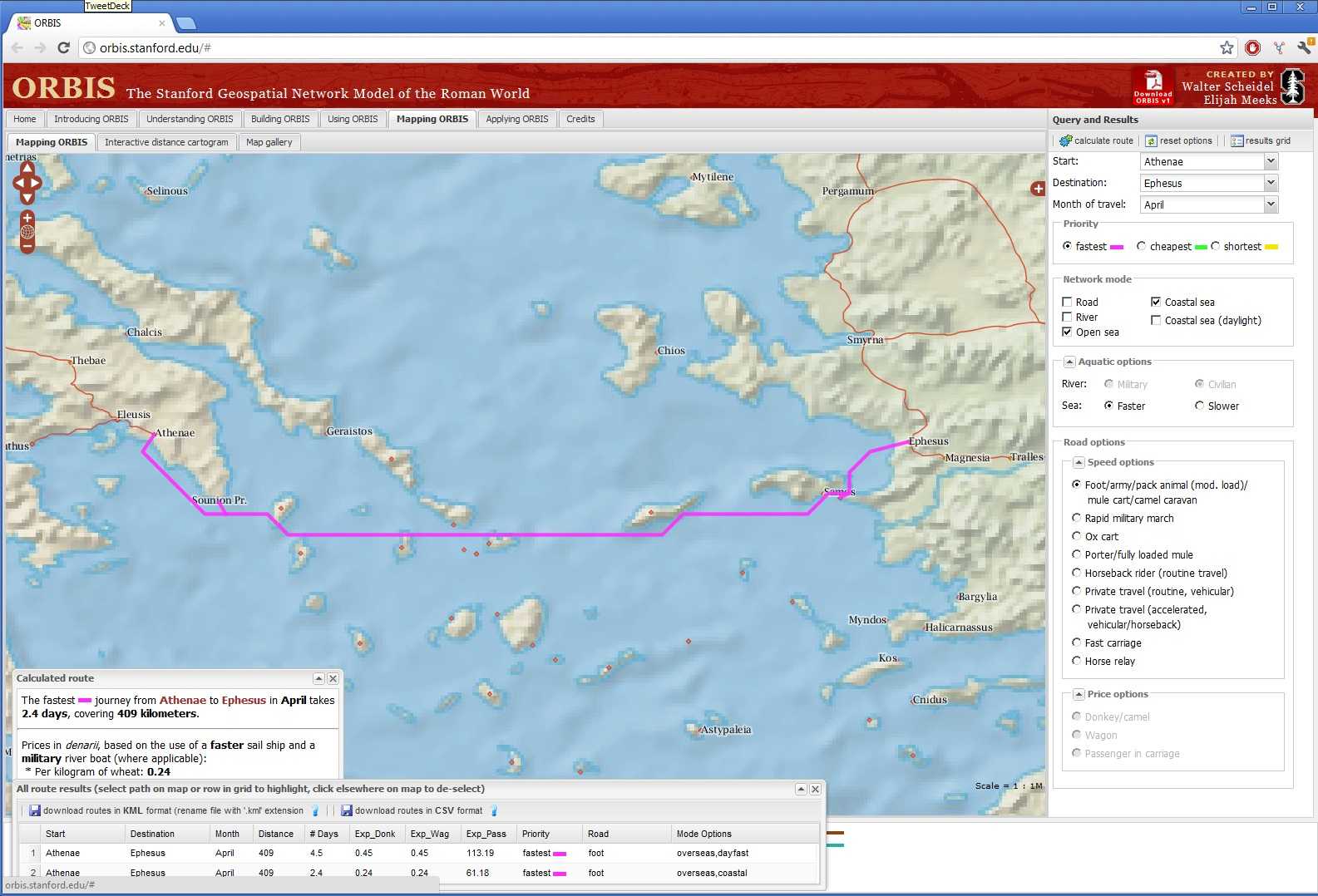
This is the route Nico and Asia took from Athens to Ephesus, aboard Salaminia, the fastest trireme ever built.
Like any ancient author dealing with travel, I worked it out with a map, a ruler, and by knowing
I figured that Salaminia could do it with only a single overnight stop and two very long days. Orbis produced 2.4 days for a standard boat on its quickest route, or 4.5 days if I restricted it to coastal waters and only daylight travel, which would be your average trader. I did notice you have to be careful with the options. If I left road travel turned on, the boat stopped on one side of an island, people got off, crossed the island by horse or donkey, then got back on another boat. Which is obviously unrealistic, but since I did allow it in my choices it's fair enough.
With a little common sense, and by modifying the result with any specific knowledge, it's guaranteed to save you piles of time. I think this thing is just awesome. This is what historical research should be in the modern world.
Drink like a Greek: wine cups
Ancient wine was quite unlike the modern stuff. To start with, they added spices, such as fenugreek, which these days you're more likely to find in a curry. They also added seawater, for a very good reason. In a world without sulphur, salt makes the next best preservative.
Wine was always drunk with water mixed in. No exceptions, not ever. To drink wine neat was the mark of the worst sort of dissolute barbarian. The usual ratio was three water to one wine. Since water filtration plants hadn't been invented yet, the practice might have begun so the alcohol could kill any bugs in the water. The water and wine was mixed together in a large jar called a krater, and then served out into cups.
Wine at a party was served in a very wide, very flat cup called a kylix. Here's one at the Metropolitan in New York:

Yes, the decoration on the outside is a naked woman drinking from a kylix. Some of the decorations on these things would be rated XXX. Speaking of which, here's a decoration on the inside of a cup. This is what you'd see after you've drunk the wine:


In The Ionia Sanction at one point I have Nico at a Persian party where he's given a rhyton to drink from in the shape of a boar.
Wine was always drunk with water mixed in. No exceptions, not ever. To drink wine neat was the mark of the worst sort of dissolute barbarian. The usual ratio was three water to one wine. Since water filtration plants hadn't been invented yet, the practice might have begun so the alcohol could kill any bugs in the water. The water and wine was mixed together in a large jar called a krater, and then served out into cups.
Wine at a party was served in a very wide, very flat cup called a kylix. Here's one at the Metropolitan in New York:

Yes, the decoration on the outside is a naked woman drinking from a kylix. Some of the decorations on these things would be rated XXX. Speaking of which, here's a decoration on the inside of a cup. This is what you'd see after you've drunk the wine:

The lady is playing a drinking game called kottabos. That's why she's holding her cup in that funny way. Here are the rules for kottabos:
- Drink your wine to the dregs.
- Hold cup as per lady in picture.
- Throw the dregs at the nearest wall.
Winners are judged for the most interesting patterns on the host's walls, or possibly the furniture or the fellow guests if someone's a bad shot.
The other, more unusual cup for alcohol, is something much more associated with Vikings, but in fact comes from Persia. The Greeks called it a rhyton, which is also the English word. It's a cup in the shape of a horn:

These things were always made in the shape of an animal or some similar subject. These are at the Getty Villa in L.A., as is this lion:

In The Ionia Sanction at one point I have Nico at a Persian party where he's given a rhyton to drink from in the shape of a boar.
Drink like a Greek: water cups
Ancient Greeks drank water and wine. Beer wasn't popular.

 Water was collected each morning from springs, wells, and, occasionally, public fountains, and carried back to the home. The most famous spring in Athens was called Kallirhoe. It was a tradition to wash in the waters of Kallirhoe on your wedding day.
Most cups were as normal-looking as modern ones, but some were works of art. The pictures left and right are of a cup in the Metropolitan Museum in New York. It's the sort of thing you would have found in a wealthy house.
And if you think people took their art seriously back then, check out this cup:

Don't ask me how they got it to stand upright.

 Water was collected each morning from springs, wells, and, occasionally, public fountains, and carried back to the home. The most famous spring in Athens was called Kallirhoe. It was a tradition to wash in the waters of Kallirhoe on your wedding day.
Most cups were as normal-looking as modern ones, but some were works of art. The pictures left and right are of a cup in the Metropolitan Museum in New York. It's the sort of thing you would have found in a wealthy house.
And if you think people took their art seriously back then, check out this cup:

Don't ask me how they got it to stand upright.
The ecclesia, the boule and the prytaneis
I thought I'd have a go at describing the power structure of classical Athens. Thinking caps on...this is complex.
Sovereign power was held by the ecclesia, and only by the ecclesia. It was a parliament consisting of every single voting member of the state. This is what makes Athens the world's first democracy. Athens was a direct democracy; you didn't elect someone to represent you; instead you turned up to vote for yourself. Ecclesia remains a word in English to this day and means a collection of churchmen. The church term comes directly from the original Athenian parliament.
There were maybe 25,000 eligible voters. Obviously they didn't all turn up for every session. The quorum for a valid vote was 6,000. On days when there wasn't much happening, they struggled to get enough voters to turn up, so the Scythian Guard would sweep through the agora with a long rope covered in wet paint, to herd the voters to parliament. Since the Scythian Guard was all slaves, this meant slaves were going around forcing their owners to run the city.
That was the simple bit.
25,000, or even the minimum 6,000 makes for a very large meeting. To keep things moving, they had a parliamentary management committee called the boule. Boule means council. They met at the bouleterion. Just about every city in Greece had a building by this name. Even the site for the Olympic Games had a bouleterion.
Everyone in Athens had to belong to one of the ten tribes, which by classical times were purely administrative units. Every year, 50 men were elected from each tribe to be members of the boule. That makes a management committee of 500 people. Clearly the Athenians liked to do things big. Since the boule set the agenda for the ecclesia, the members of the boule should have been very powerful. Their large membership and only holding the office for a year kept them in check.
Since boule membership only lasted a year, you could cycle through the entire voting population in 50 years. Obviously not everyone got a go on that scheme, but the great majority would have.
Because 500 was still too large, they had a management committee for their management committee. They selected 5 men from each of the ten tribes represented in the boule to form a subgroup called the prytaneis. So that made 50 men in the prytaneis. They rotated membership of the prytaneis each tenth of a year. So if you were elected to the boule, you'd spend 36 days as a prytaneis.
The good news for the prytaneis was, they ate for free -- at public expense -- because they were required to spend their 36 days living in a building in the agora called the Tholos. The Tholos gets a mention in The Pericles Commission because they were building it at the very moment the book begins. Most unusually for Athenian architecture, it was designed as a perfect circle. Members of the prytaneis could call a meeting of the ecclesia -- the entire citizenry of Athens -- at any time. In effect, the prytaneis could press the emergency alert button. Which in a few crisis situations they did.
So: Athens was ruled by the ecclesia of about 25,000 voting citizens. The ecclesia was managed by the boule of 500 citizens. The boule was managed by 50 of their number called the prytaneis.
Athens had a very clear distinction between sovereign and executive power. Much clearer than in modern times, when we tend to mix them up. Executive power was wielded by the archons for civil matters and the strategoi for military. Neither had any say (in theory) on what the people decided. I'll save those for another day or this post will get way too long.
Sovereign power was held by the ecclesia, and only by the ecclesia. It was a parliament consisting of every single voting member of the state. This is what makes Athens the world's first democracy. Athens was a direct democracy; you didn't elect someone to represent you; instead you turned up to vote for yourself. Ecclesia remains a word in English to this day and means a collection of churchmen. The church term comes directly from the original Athenian parliament.
There were maybe 25,000 eligible voters. Obviously they didn't all turn up for every session. The quorum for a valid vote was 6,000. On days when there wasn't much happening, they struggled to get enough voters to turn up, so the Scythian Guard would sweep through the agora with a long rope covered in wet paint, to herd the voters to parliament. Since the Scythian Guard was all slaves, this meant slaves were going around forcing their owners to run the city.
That was the simple bit.
25,000, or even the minimum 6,000 makes for a very large meeting. To keep things moving, they had a parliamentary management committee called the boule. Boule means council. They met at the bouleterion. Just about every city in Greece had a building by this name. Even the site for the Olympic Games had a bouleterion.
Everyone in Athens had to belong to one of the ten tribes, which by classical times were purely administrative units. Every year, 50 men were elected from each tribe to be members of the boule. That makes a management committee of 500 people. Clearly the Athenians liked to do things big. Since the boule set the agenda for the ecclesia, the members of the boule should have been very powerful. Their large membership and only holding the office for a year kept them in check.
Since boule membership only lasted a year, you could cycle through the entire voting population in 50 years. Obviously not everyone got a go on that scheme, but the great majority would have.
Because 500 was still too large, they had a management committee for their management committee. They selected 5 men from each of the ten tribes represented in the boule to form a subgroup called the prytaneis. So that made 50 men in the prytaneis. They rotated membership of the prytaneis each tenth of a year. So if you were elected to the boule, you'd spend 36 days as a prytaneis.
The good news for the prytaneis was, they ate for free -- at public expense -- because they were required to spend their 36 days living in a building in the agora called the Tholos. The Tholos gets a mention in The Pericles Commission because they were building it at the very moment the book begins. Most unusually for Athenian architecture, it was designed as a perfect circle. Members of the prytaneis could call a meeting of the ecclesia -- the entire citizenry of Athens -- at any time. In effect, the prytaneis could press the emergency alert button. Which in a few crisis situations they did.
So: Athens was ruled by the ecclesia of about 25,000 voting citizens. The ecclesia was managed by the boule of 500 citizens. The boule was managed by 50 of their number called the prytaneis.
Athens had a very clear distinction between sovereign and executive power. Much clearer than in modern times, when we tend to mix them up. Executive power was wielded by the archons for civil matters and the strategoi for military. Neither had any say (in theory) on what the people decided. I'll save those for another day or this post will get way too long.
How to get divorced in ancient Athens
I and the family are on holidays in a lovely town called Coff's Harbour, about 6 hours north of Sydney. I'm writing this on a netbook tethered to an iPhone, so only the net.gods know how it's going to look when I'm finished. Anyway, here goes...
People who've been reading this blog for some time know that much of it is research overflow from my books. You can't put everything you know into a story. So as not to waste anything, I put the leftovers here. Given the title of this post you might therefore presume that in some future book, someone's going to get divorced.
In classical Athens, if a man wanted to divorce his wife, he needed only to say so. The wife was then required to leave the marriage home. She would have to go live with her closest male relative, who typically would be her father if he was still alive, or else a brother. But there was a kicker to this. Not only did the wife leave, but her dowry went with her. Every last drachma. Or if it was property, every last little bit of land. This was totally enforceable by law.
The Greek dowry system, you see, was like the ancient version of a trust fund in the lady's name, to be administered by her husband for her benefit. Obviously in the normal course of a happy married life it's all in the family, and when the wife dies her dowry would be inherited by her sons. But in the event of divorce the dowry does not belong to the husband. It's the woman's retirement fund, supplied by her father. This meant that the larger the dowry, the less likely an unhappy marriage was to break down. There was more than one man dependent on his wife's dowry property for most of his income.
Women too could declare a divorce, but the process for them was slightly different. An unhappy wife had to leave her home, walk to the agora, which in addition to being the marketplace was also where all the government offices were, find an archon (that's a city official), and tell him she wanted to divorce. Quite what happened during the conversation is unclear -- there's not a single surviving text to tell us -- I presume that at the least the archon would satisfy himself that the lady had a male relative to go to. But the archon would then agree, and at that instant the divorce was complete. She then left the home, with her dowry.
The divorce rate was much, much smaller than modern times. Also there was no such thing as gossip rags back then (we've definitely gone downhill on that one). Consequently there are only a handful of documented divorce cases. The cases however make it clear that women could divorce simply by seeing an archon.
This rule led to the most bizarre divorce case in the city's history.
There was a General and politician by the name of Alcibiades, whose wife Hipparete despaired of him because he constantly consorted with prostitutes. Unable to take it any more, she began the walk to the agora. Her husband Alcibiades got wind of this. He turned up just as she was crossing the agora, picked her up bodily, and carried her home. She never tried again.
Alcibiades' actions were far from the norm, so much so that people were still talking about it hundreds of years after it happened.
Now here's the converse: there's actually a case where a couple were sued in an ancient Athenian court to prove that their divorce was a sham. It seemed the husband was due to pay a large sum. But unfortunately for his debtors, almost all his property had come as his wife's dowry, and it just so happened that she had divorced him moments before the debt fell due. The debtors promptly sued, asking what archon had heard the wife's divorce (it turned out not a single archon had a record of talking to her), and pointing out that they were still living together. This scam is absolutely identical to the modern version, where a man about to go bankrupt, or be sued, transfers all his property into his wife's name to quarantine it from being taken. It seems like such a modern scam, but it was invented in classical Athens.
People who've been reading this blog for some time know that much of it is research overflow from my books. You can't put everything you know into a story. So as not to waste anything, I put the leftovers here. Given the title of this post you might therefore presume that in some future book, someone's going to get divorced.
In classical Athens, if a man wanted to divorce his wife, he needed only to say so. The wife was then required to leave the marriage home. She would have to go live with her closest male relative, who typically would be her father if he was still alive, or else a brother. But there was a kicker to this. Not only did the wife leave, but her dowry went with her. Every last drachma. Or if it was property, every last little bit of land. This was totally enforceable by law.
The Greek dowry system, you see, was like the ancient version of a trust fund in the lady's name, to be administered by her husband for her benefit. Obviously in the normal course of a happy married life it's all in the family, and when the wife dies her dowry would be inherited by her sons. But in the event of divorce the dowry does not belong to the husband. It's the woman's retirement fund, supplied by her father. This meant that the larger the dowry, the less likely an unhappy marriage was to break down. There was more than one man dependent on his wife's dowry property for most of his income.
Women too could declare a divorce, but the process for them was slightly different. An unhappy wife had to leave her home, walk to the agora, which in addition to being the marketplace was also where all the government offices were, find an archon (that's a city official), and tell him she wanted to divorce. Quite what happened during the conversation is unclear -- there's not a single surviving text to tell us -- I presume that at the least the archon would satisfy himself that the lady had a male relative to go to. But the archon would then agree, and at that instant the divorce was complete. She then left the home, with her dowry.
The divorce rate was much, much smaller than modern times. Also there was no such thing as gossip rags back then (we've definitely gone downhill on that one). Consequently there are only a handful of documented divorce cases. The cases however make it clear that women could divorce simply by seeing an archon.
This rule led to the most bizarre divorce case in the city's history.
There was a General and politician by the name of Alcibiades, whose wife Hipparete despaired of him because he constantly consorted with prostitutes. Unable to take it any more, she began the walk to the agora. Her husband Alcibiades got wind of this. He turned up just as she was crossing the agora, picked her up bodily, and carried her home. She never tried again.
Alcibiades' actions were far from the norm, so much so that people were still talking about it hundreds of years after it happened.
Now here's the converse: there's actually a case where a couple were sued in an ancient Athenian court to prove that their divorce was a sham. It seemed the husband was due to pay a large sum. But unfortunately for his debtors, almost all his property had come as his wife's dowry, and it just so happened that she had divorced him moments before the debt fell due. The debtors promptly sued, asking what archon had heard the wife's divorce (it turned out not a single archon had a record of talking to her), and pointing out that they were still living together. This scam is absolutely identical to the modern version, where a man about to go bankrupt, or be sued, transfers all his property into his wife's name to quarantine it from being taken. It seems like such a modern scam, but it was invented in classical Athens.
A killing financial problem
Sometimes, it just sucks to be an accountant. Back in classical Athens, there was a group of ten city officials, elected yearly, called the Hellenotamiae. They were the official city treasurers, their job to manage the money vault buried beneath the Parthenon. The sums they handled were vast.
The Athenians, being the untrusting souls they were, checked the accounts on a regular basis. On one occasion, the numbers didn't add up. The ten treasurers were instantly charged with embezzlement.
This is what happened, from a surviving court case that mentions this unfortunate incident as a precedent:
The Eleven was the official Athenian body responsible for carry out state executions. In other words, Sosias had been in the hands of his executioners when they retrieved him. The implication of the "it was shown how the money had disappeared" is that it was a mistake in the books.
So the other nine treasurers died for an accounting error.
The Athenians, being the untrusting souls they were, checked the accounts on a regular basis. On one occasion, the numbers didn't add up. The ten treasurers were instantly charged with embezzlement.
This is what happened, from a surviving court case that mentions this unfortunate incident as a precedent:
Then again, your Hellenotamiae were once accused of embezzlement... Anger swept reason aside, and they were all put to death save one. Later the true facts became known.
This one, whose name is said to have been Sosias, though under sentence of death, had not yet been executed. Meanwhile it was shown how the money had disappeared. The Athenian people rescued him from the very hands of the Eleven, while the rest had died entirely innocent.
The Eleven was the official Athenian body responsible for carry out state executions. In other words, Sosias had been in the hands of his executioners when they retrieved him. The implication of the "it was shown how the money had disappeared" is that it was a mistake in the books.
So the other nine treasurers died for an accounting error.
The law and and beauty in ancient Athens
Over at Criminal Element I have a guest post today. I waffled a bit about how laws and courts worked back then, wandering from the laws of Draco (who's the guy we get the word draconian from), to the infamous incident that happened to Phryne when she was in court.
Criminal Element is a mystery fan site run by Macmillan. If you're interested, take a look.
Criminal Element is a mystery fan site run by Macmillan. If you're interested, take a look.
The Long Walls
The Long Walls were like something out of epic fantasy, with the added advantage that they were totally real. A few small parts of them still exist.
In this map, Athens is the pink blobby bit in the top right. Piraeus is the green blobby bit in the bottom left. Those two lines you see connecting them are the Long Walls. As you can see, they're long!

There was a wall built around central Athens, and Piraeus was a reinforced naval fortress. Athens, Piraeus and the Long Walls together formed one, huge, dumb-bell shaped fortification.
Why did they do this? Well, about two decades before my stories begin, a rather bright lad by the name of Themistocles realized that the safety of Athens required a massive fleet. I've previously talked about how huge the Athenian fleet was. At this time, they had about 200 triremes. They needed somewhere to dock and maintain all those boats, so Themistocles decided to turn a teensy fishing village called Piraeus into a massively fortified naval base, and in so doing he set the future of Greece for the next 2,500 years. To this day, Piraeus is their major port.
The only problem was the distance between Athens and Piraeus. An invading army -- Sparta would be a likely choice -- could stand in between to cut off the Athenians from their fleet.
So Themistocles decided to build the Long Walls. Even back then, they were sometimes called the Walls of Themistocles.
There's a paradox with the dating of these things. The historian Thucydides states that Themistocles caused the walls to be built, and he states that they were built in 458BC. The dating on this is technical. A Spartan army attacked to try to prevent the walls being completed, and it's possible to show this happened in 458, or roundabouts.
But Themistocles was ostracized in 470BC, 12 years before, and then condemned for treason. He never returned to Athens. How could he have caused walls to be built 12 years after he was gone? And why would the Athenians name a major defensive structure after a traitor? On the face of it, this is impossible!
Historians almost universally go with the 458 date, and don't have a good answer for the Themistocles question. But I wanted those walls to be there in 461BC, and besides, I think the date paradox needs to be solved.
It occurred to me that the walls might have been built twice. It might be that, after the Persian Wars, Themistocles caused a rapidly-constructed wooden wall to be built, and that subsequently it was replaced with a more permanent solution. Thucydides states point blank that the wall erected in 458 was of stone. A wood-to-stone conversion makes sense, especially since, after twenty years, they'd be starting to see maintenance issues.
Also, disregarding the recorded history, purely as a piece of military thinking, it's inconceivable to me that they would wait 20 years after the Persian Wars to build something so vital to their core naval strategy.
When I checked archaeological records (always check the archaeology) I discovered a report that suggested a small part of the remaining ruined wall structure seems to have been made of wood. That's not nearly enough to prove my theory by rigorous academic standards, but for a humble author of historical fiction, we're just fine.
Ta-da! Life is good.
So the walls Nico sees are specifically described as wooden, not stone.
If you'd been standing in the middle of the Long Walls back in 460BC, you would have seen huge amounts of traffic up and down, from the moment dawn broke. Fishermen landed their catch at Piraeus and carted it up to Athens, to sell in the agora. Workmen trundled their way back and forth. Navy men who lived in Athens walked down to their ships. Merchants with imported goods carted them off the cargo ships and up to the big city.
These days there's a bus route that runs where the Long Walls used to be, and I think the green line of the Athens metro is more or less on the same path too, but in Nico's day the only way up or down was to walk, or take a cart.
Guest post at Working Stiffs
Today I was invited by Joyce Tremel to write a guest blog over at the site of a collection of crime authors, who go by the interesting name Working Stiffs.
With a blog name like that, what else could I write about, but the Working Stiffs of Classical Athens.
Joyce has a little bit of good news of her own. Only a few days ago, she signed with the highly talented, young literary agent Mer Barnes, who used to work for Janet Reid, who in turn is my agent. So that makes Joyce my writer-cousin.
With a blog name like that, what else could I write about, but the Working Stiffs of Classical Athens.
Joyce has a little bit of good news of her own. Only a few days ago, she signed with the highly talented, young literary agent Mer Barnes, who used to work for Janet Reid, who in turn is my agent. So that makes Joyce my writer-cousin.
School daze
School in classical Athens wasn't compulsory, but a father who didn't send his boys to school had about the same status as a leper, so effectively every boy got an education. Girls were educated at home; which might annoy the ladies reading this, but in fact by the time I'm finished you might think the girls were the ones better off.
The first thing all kids were taught was how to read and write. Literacy levels were high. Very high. And that applies to both women and men. They might have had the highest general literacy until our modern age; and even then there are a few modern nations with literacy levels probably below that of classical Athens. A common insult of the time was to say of someone, "He can't swim and he can't read." Meaning, "This guy is a total idiot." In a civilization of islands that relied on trade, swimming was a basic survival skill. By implication, so too was reading.
Every play, every history, every document of the time takes it for granted that the women could read as well as the men. Also, plenty of pottery shows women playing musical instruments. Literacy and music covers off two thirds of the male curriculum.
The boys learned these things: reading and writing, music, poetry, "wrestling" (sport), and the big one...reciting Homer.
A boy who didn't learn his Homer to a minimum standard could expect some beatings. Homer was way too large for any normal person to remember it all, but there were core parts everyone had to know. (Though having said that, Diotima can recite all of Homer end to end, and so too could a professional bard of the time). If you read any dialogue from the period — the dialogues in Plato are a good example — you'll see that educated Athenians threw in quotes from Homer in their conversation in much the same way that Victorian period Englishmen threw in Latin tags. I don't do that in my stories because it would drive you insane, though I've popped in the occasional easily recognized tag. In The Ionia Sanction, as an experiment I put a quote from Homer at the top of every chapter. The one at the start of chapter one is, "Evil deeds do not prosper; the slow man catches up with the swift."
With every boy going to school, there were obviously a lot of schools. Almost certainly every deme had its own school, and the more populous demes probably had several. (A deme was like a suburb; in fact many ancient demes are suburbs in modern Athens.)
There are numerous texts from the time extolling the virtues of a good beating to instill moral fiber in the weak. The same didn't apply to the girls. Dr Arnold of Rugby School would probably have approved.
The Athenians had to pass a law limiting the school day to from dawn to dusk. I'm not kidding. No doubt when it was passed, the teachers grumbled how kids had it too soft these days, but they seem to have stuck to the letter of the law. So an Athenian boy rose before dawn, arrived at school as the sun peeked over the horizon, and returned home when it was dark. And let me point this out...no weekends! Religious festival days were the only respite for the boys.
With every boy going to school, there were obviously a lot of schools. Almost certainly every deme had its own school, and the more populous demes probably had several. (A deme was like a suburb; in fact many ancient demes are suburbs in modern Athens.)
There are numerous texts from the time extolling the virtues of a good beating to instill moral fiber in the weak. The same didn't apply to the girls. Dr Arnold of Rugby School would probably have approved.
The Athenians had to pass a law limiting the school day to from dawn to dusk. I'm not kidding. No doubt when it was passed, the teachers grumbled how kids had it too soft these days, but they seem to have stuck to the letter of the law. So an Athenian boy rose before dawn, arrived at school as the sun peeked over the horizon, and returned home when it was dark. And let me point this out...no weekends! Religious festival days were the only respite for the boys.
Dedicating your toys to Artemis
I gave a talk at my daughters' school a few months ago, and much fun it was. They were studying ancient Greece, so I was a fairly natural addition to the curriculum. I waffled on for an hour about things that I thought would interest the girls. I talked about hairstyles, how children dressed (it was the previous post that reminded me of this), about schools and how kids took part in the festivals and how girls went to the sanctuary at Brauron. Then I mentioned in passing that ancient Greek girls, before they married, were required to dedicate all their toys to the goddess Artemis.
Fifteen minutes later, I was still fielding questions as the girls desperately looked for ways around this evil rule.
They were shocked.
The dedication is obviously a coming-of-age ritual. A maiden puts away her childish things before she becomes a wife. Or more accurately, it worked like this:
When a girl was born she was a kore, which means maiden. When she's betrothed she becomes a nymphe, and nymphe she remains until motherhood, when she became a gyne.
It's not quite the same as the maid, the mother, and the crone that's commonly found in neo-pagan beliefs. But kore-nymphe-gyne was the true progression that the Greeks used, and the dividing lines are marriage and motherhood. The dedication of the toys was part of the transformation. The girl went to the temple, no doubt with her family, where in a ceremony she placed her toys somewhere within the temple, then she left without them; no longer a girl, but a young woman.
Based on the persistence of the girls I spoke to, I have no doubt there was more than one favourite doll that went missing at age 13, that magically reappeared at age 16. There were probably some other brilliant schemes to save toys. But in general the girls seem to have followed the rules. There are a few surviving dedications which we can read today. The clearest I know of is this one:
Fifteen minutes later, I was still fielding questions as the girls desperately looked for ways around this evil rule.
They were shocked.
The dedication is obviously a coming-of-age ritual. A maiden puts away her childish things before she becomes a wife. Or more accurately, it worked like this:
When a girl was born she was a kore, which means maiden. When she's betrothed she becomes a nymphe, and nymphe she remains until motherhood, when she became a gyne.
It's not quite the same as the maid, the mother, and the crone that's commonly found in neo-pagan beliefs. But kore-nymphe-gyne was the true progression that the Greeks used, and the dividing lines are marriage and motherhood. The dedication of the toys was part of the transformation. The girl went to the temple, no doubt with her family, where in a ceremony she placed her toys somewhere within the temple, then she left without them; no longer a girl, but a young woman.
Based on the persistence of the girls I spoke to, I have no doubt there was more than one favourite doll that went missing at age 13, that magically reappeared at age 16. There were probably some other brilliant schemes to save toys. But in general the girls seem to have followed the rules. There are a few surviving dedications which we can read today. The clearest I know of is this one:
Timareta, the daughter of Timaretus, before her wedding, has dedicated to you, Artemis of the Lake, her tambourine and her pretty ball, and the net that kept up her hair, and her dolls too, and their dresses; a virgin's gift, as is fit, to a virgin goddess.
Dress like a Greek
In every book I've written, I've included a few paragraphs of explanation about ancient Greek clothing. And in every book, I've taken those paragraphs out before it goes to the publisher, because explanation is exposition, and Exposition Is A Bad Thing™.
Herewith, so I can stop typing the same thing over and over, is how to Dress Like A Greek. This should help next time you're going to atoga chiton party.
To make a basic chiton:
To finish off, get hold of a long, wide scarf made of pure wool. Drape this over your shoulders and down an arm. This is your himation.
The chiton was the standard dress for all women and upper class men. The chiton + himation combo was the ancient equivalent of a suit and tie. It was probably about as practical too.
Diotima is a lady of perfect modesty. She always wears a chiton. She has a collection of silver earrings, necklaces and bracelets that display her exquisite taste. When she has to shoot her bow, she pulls the right sleeve up to her shoulder and hooks it over one of the fibulae. Her target is unlikely to live long enough to be offended by the fashion crime.
Note that there were no hems in any clothing. Also, Greek clothing was never cut or tailored. Two rectangles of fabric is what you have to work with. I've driven illustrators and book production people to drink by telling them the elegantly tailored tunics that they've put on Nico and Diotima are lovely but wrong.
I should emphasize that, as with modern clothing, there appears to have been considerable variation in the designs. I should also emphasize that there isn't a single surviving example of a real classical Greek chiton, so everyone's staring at the same vase pictures to guess how they were made.
A chitoniskos is a little chiton. Boys often wore daddy's old, cast-off chiton, cut down to size. Take the chiton you've just made, cut it so it ends above the knees. and cut the sides until it's slightly too large for the target child (these kids tend to grow). Socrates wears a chitoniskos, whenever he can be forced to wear anything at all.
Artisans and middle class workers didn't wear chitons. There's no way you could do practical labour wearing that thing. Instead, they wore an exomis. Chitons are unisex, but the exomis is men-only. Here's how to make an exomis:
Everything reverses for left handed men. Sew the left side rather than the right, and tie over the right shoulder. You can actually tell if someone is left or right handed by which side they wear their exomis knot.
The exomis is obviously very loose, and anyone looking from the left side is going to get an eyeful, but the Greeks weren't exactly bashful and even walking around naked was perfectly acceptable.
Nico almost always wears an exomis. That's partly because he comes from an artisan family where the exomis is standard daily work wear for his dad, but it's mostly because it's so much easier to battle bad guys with less material to deal with. The one time he tried to knife fight in a chiton, he tripped over.
Herewith, so I can stop typing the same thing over and over, is how to Dress Like A Greek. This should help next time you're going to a
To make a basic chiton:
- Stand and hold your arms outstretched to the sides.
- Have a friend measure you from wrist to wrist, and shoulder to ankles.
- Cut two sheets of linen. Bedsheets are a traditional source.
- Dye the two sheets in bright colours. You can go to town on this. Greek clothing was as colourful as they could make it. Typically there'd be a border and within that, some sort of symmetrical pattern.
- Sew the sheets together down the right hand side, leaving a space for the arms.
- You're done with the manufacturing. Wasn't that simple!
- Put your right arm through the gap you left in the sewn side. Use pins — fibulae — to attach the front and back at both shoulders. Ancient Greek fibulae were ornate, silver affairs. Large broaches are a decent modern equivalent.
- Pin the left side.
- Tie a belt rope around the waist. This can afford to be tight because, as you're probably noticing by now, there is a lot of extra material.
- The Greeks didn't have bras, I'm devastated to report. Tie a rope beneath the relevant bits and then across the chest in a cross and over the shoulders where it can be tied at the back. With all that extra material up top you can get a similar effect. Greeks liked to thread colourful strands into the belt and chest ropes to make them pretty.
 |
| The woman on the right wears a chiton. The young lady on the left wears a chitoniskos. |
The chiton was the standard dress for all women and upper class men. The chiton + himation combo was the ancient equivalent of a suit and tie. It was probably about as practical too.
Diotima is a lady of perfect modesty. She always wears a chiton. She has a collection of silver earrings, necklaces and bracelets that display her exquisite taste. When she has to shoot her bow, she pulls the right sleeve up to her shoulder and hooks it over one of the fibulae. Her target is unlikely to live long enough to be offended by the fashion crime.
I should emphasize that, as with modern clothing, there appears to have been considerable variation in the designs. I should also emphasize that there isn't a single surviving example of a real classical Greek chiton, so everyone's staring at the same vase pictures to guess how they were made.
A chitoniskos is a little chiton. Boys often wore daddy's old, cast-off chiton, cut down to size. Take the chiton you've just made, cut it so it ends above the knees. and cut the sides until it's slightly too large for the target child (these kids tend to grow). Socrates wears a chitoniskos, whenever he can be forced to wear anything at all.
Artisans and middle class workers didn't wear chitons. There's no way you could do practical labour wearing that thing. Instead, they wore an exomis. Chitons are unisex, but the exomis is men-only. Here's how to make an exomis:
- Do the stand-and-measure thing as before. But stop at the elbows, or even less, according to taste.
- Sew down the right, as before.
- Now, when you put it on from the right, forget about pins. Just tie the top left corners over the left shoulder.
- You're done!
 |
The exomis is obviously very loose, and anyone looking from the left side is going to get an eyeful, but the Greeks weren't exactly bashful and even walking around naked was perfectly acceptable.
Nico almost always wears an exomis. That's partly because he comes from an artisan family where the exomis is standard daily work wear for his dad, but it's mostly because it's so much easier to battle bad guys with less material to deal with. The one time he tried to knife fight in a chiton, he tripped over.
Horos stones
Ancient Greeks were not particularly good at public records. In fact, to tell the truth, they sucked at it.
This wasn't as big a problem as you might think; it's only recently that modern people have taken the view that life is impossible unless every little detail gets written down.
There was one point, however, where the Greeks needed to do better, and that was recording who owned what land. Believe it or not, there was no registry of land ownership. This made for an interesting problem.
They solved the problem by putting boundary stones around everyone's property. Horos means limit, or boundary. A horos stone is a boundary marker with a legal enforceable meaning. The stones were normally quite large, I suspect they were typically painted white to make them easy to see. Most, but not all, had something written on them: a standard formula declaring the stone to be a legal boundary.
All land, to be legally owned, had to be enclosed by horos stones placed at regular intervals. I think the usual interval was probably a stade, that being the length of the Olympic competition field, and the origin of our word stadium.
Here, from the excellent stoa.org, is one of the surviving horos stones for the agora in Athens. There's an inscription on it that reads, "I am the boundary of the agora." (Horos stones always spoke in first person.)

This wasn't as big a problem as you might think; it's only recently that modern people have taken the view that life is impossible unless every little detail gets written down.
There was one point, however, where the Greeks needed to do better, and that was recording who owned what land. Believe it or not, there was no registry of land ownership. This made for an interesting problem.
They solved the problem by putting boundary stones around everyone's property. Horos means limit, or boundary. A horos stone is a boundary marker with a legal enforceable meaning. The stones were normally quite large, I suspect they were typically painted white to make them easy to see. Most, but not all, had something written on them: a standard formula declaring the stone to be a legal boundary.
All land, to be legally owned, had to be enclosed by horos stones placed at regular intervals. I think the usual interval was probably a stade, that being the length of the Olympic competition field, and the origin of our word stadium.
Here, from the excellent stoa.org, is one of the surviving horos stones for the agora in Athens. There's an inscription on it that reads, "I am the boundary of the agora." (Horos stones always spoke in first person.)

Needless to say, there were countless court cases where one farmer claimed his neighbour had moved the boundary stones. In those cases it all hung on witnesses. Since the stones were embedded in the ground, moving them would leave fairly obvious holes, even if the culprit filled them with fresh dirt. Also everyone in the area would know everyone else's business and if the boundary shifted locals would probably spot it.
If you wanted to sell land, then the law varied wildly from city to city. In Athens — I'm on shaky ground here, but I think I have it right — both parties had to post the sale with one of the city magistrates for 60 days, after which it was a done deal as long as no one objected. This rule was presumably to ensure no scammer sold someone else's property. There was actually no other defense. I can only assume a few con artists got away with it.
Akropolis, by von Klenze
Leo von Klenze painted in 1846 this idealized view of the Acropolis in the time of Pericles. I'm glad the title includes the word "idealized", because there are a few things wrong with the accuracy. Even so I suspect it does a terrific job of capturing the feel of what it was like back then, especially the Parthenon and the walk up to the Propylaea. That's the building you see smack in the middle, with the steps leading up to it. The mega-statue rising from behind the Proplyaea can't possibly be real.

I can't believe the Areopagus -- that's the rock platform in the foreground where the crowd is milling about -- was ever as flat as von Klenze has it. If you visit today you'll see that the Areopagus is very up and down in its top surface, and I doubt it's all due to wear. Also, there's no way there was ever an ornate marble building on top as shown at the left. I do think there was a large wooden structure for meetings of the Council of the Areopagus. But this is all carping. The point is, he captured the spirit of the place.
This picture is interesting to me because in the center of it is where I killed my first victim, on line 1 of my first book:

Subscribe to:
Posts (Atom)