Showing posts with label Music. Show all posts

Classical Greek music

Music is a Greek word and comes directly from the nine Muses, daughters of Zeus who inspired men in the arts.  Mousike techne was the technique of music.  The particular Muse who inspired music was named Euterpe, a name that will be familiar to readers of my books since it's also the name of my heroine Diotima's mother.  

As it happens, we have some surviving notated ancient music.  Which means we can play it.

The ancient Greeks created a tuning system that was the direct ancestor of our major scale.  Their idea was to use a sequence of perfect fifths that wrap around at the octave boundary.  This idea was so successful that we still use it today, slightly modified.

If you check the sequence of major scale notes in our modern tuning system, you'll find that the sequence of root -> fifth -> second -> sixth -> third -> seventh -> fourth is indeed a sequence of fifths (7 semitones each jump), except for the fourth, which is only a 6 semitone jump so that the gap from fourth to the octave would be a perfect fifth and thus complete the cycle.  This was squeezing the ancient system onto a modern instrument with twelve equally spaced pitches, but it works well enough.

So the Greeks invented the white keys on the piano, but they had no idea that the black keys existed. The old tuning system is called Pythagorean, because the first person to write about it was Pythagoras. That's the same Pythagoras who did the theorem about triangle sides that you learned at school. Pythagoras's book is lost, but we know bits of it because Plato, Aristotle and a few others quoted Pythagoras in their own books.

Thus the major scale is at least 2,600 years old (and is probably much older). 

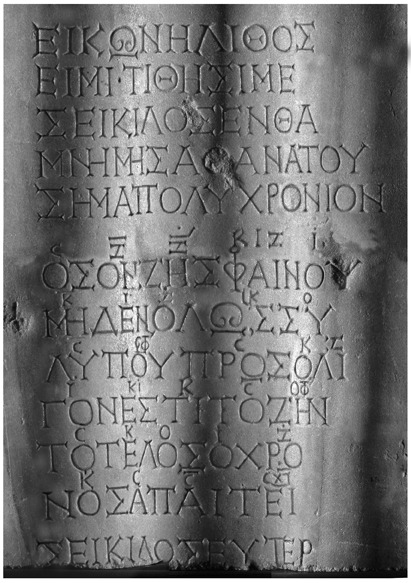
There's also a surviving gravestone on which was written a short piece of ancient music. It's called the Song of Seikilos.  That's it to the left.

The first section is a standard inscription.  It says something like:  I am a gravestone. Seikilos placed me here, an everlasting monument of deathless remembrance.

 Then the next section is a song!  This is hugely important because it's the oldest known complete song for which there is no doubt whatsoever what the notes are.  The lyrics are the engraved words (of course).  But just above the letters you'll see funny, smaller symbols.  That's the music notation.  The position of the symbol above the word shows when to play the note as you sing.  Since it has the lyrics and the melody, this is a lead sheet, in modern parlance.

This gravestone dates to zero AD, give or take a hundred years.  There are fragments of music that are very much older, but none complete, and everything older than the Song of Seikilos requires some educated guess work to reconstruct it.

The lyrics say this:

While you live, shine,
Have no grief at all.
Life exists only for a short while,
And time demands its toll.
There have been lots of renditions of the song.  Here's an instrumental only version that I suspect is very close to what you would have heard if you'd met Seikilos.  This is played by researcher Michael Levy, who built a period instrument.


Death by theremin in Midsomer County

I'm a big fan of Midsomer Murders, a TV series made by the BBC ITV (thanks Robert for the correction).  Midsomer Murders is full of quirky characters doing the most bizarre things in some of the most picturesque English villages you'll ever see.   Think seriously unhinged Agatha Christie and you've got the right idea.

It also has some distinctive theme music.

What I didn't realize until today is that the theme music is played on a theremin.

What is a theremin, I hear you scream?  It was the world's first electronic musical instrument, invented by a Russian physicist in the 1920s.  It consists of two aerials at right angles to each other.  Put your hand close to one aerial and it raises the pitch.  Putting your hand close to the other raises the volume.  Moving your hands inside the two electromagnetic fields creates music.

So here is Celia Sheen, Britain's foremost classical thereminist, who is in fact the musician you hear in every Midsomer Murder.  I know it looks like she's waving her hands in mid-air, but she really is playing the theremin.


Pythagorean Tuning

Ancient Greece had only four musical instruments that got much air play:  the aulos, which was a V-shaped double flute, pan pipes, the kithara and the lyre.  MP3 players were thin on the ground back then, and music notation was primitive and not much written, so we have almost no idea what the music sounded like.  (Though there've been attempts to reconstruct based on the few surviving lines of notation).

But weirdly, we have a very precise knowledge of how the instruments were tuned.

That's because one day, a lad by the name of Pythagoras noticed a few things about how the kithara and lyre players tuned their strings.  This is the same Pythagoras who came up with the theorem you learned in school about triangles, so it will come as no surprise that he did a minute analysis.

What Pythagoras noticed was firstly, that a string twice as long as another produced the same note but one octave down.  Ditto that a string exactly half the length was precisely one octave up.  This is a piece of pure physics that anyone could spot.

The second thing he noticed, and this was hugely important, was that musicians consistently went for a note in between the octave ends that divided the string in the ratio 3:2.

Musicians will be nodding their heads knowingly, because these days we'd call that ratio a perfect fifth.  Ancient Greek music was based entirely on perfect fifth intervals.  What's more, the interval from the perfect fifth to the next octave up is what we'd call a fourth.  We almost have enough to play the blues.

With no electronic tuners and no way to delicately adjust string tension, probably the best they could manage was to get every string to the same tension and vary the lengths.

So here's how they tuned:  start with a note X, with a string that I'll call a length of 1.  (X has some arbitrary frequency that the musician's picked by ear.)

Now the next octave up is a string of length 2:1 compared to the first string.

The perfect fifth between those octave notes is at 3:2.   That's the first perfect fifth.

Remember in this system, we get each successive note in the scale by going up a perfect fifth from the last.  So to get the perfect fifth up from one at 3/2, we have to multiply the length again by 3/2.  That gives us 9/4. The only problem is, 9/4 is more than 2:1.  We've fallen off the end of the scale!

Not to worry, just drop that note down an octave.  Which we do by halving the string.  That note becomes 9:8.

Our scale now has notes at:  1, 9:8,  3:2, and 2:1

We now go up a perfect fifth from the 9:8 note.  Which we do by multiplying it once again by 3/2.  That gives us a note at 27:16.  Our scale now has notes:  1, 9:8,  3:2, 27:16, 2:1

I won't leave you in suspense.  Here's the final Pythagorean Scale:

1:1   9:8   81:64   4:3   3:2   27:16   243:128   2:1

It's doubtful that Pythagoras invented this.  It's much more likely that he formalized a system that was already in place.  But I'd be willing to bet anything he was the first to work out the ratios.  Musicians were probably tuning up perfect fifths by ear.

You could, in theory, continue adding notes forever, but Pythagoras stopped at 8, presumably because of the practical difficulty of adding more strings.

Pythagorean Tuning was unbelievably successful.  The Greeks used it.  The Romans used it.  It survived to be used in mediaeval times.  In fact it survived until another genius by the name of Johann Sebastian Bach finally killed it off when he wrote a work called The Well Tempered Klavier in the 1700s.

Believe it or not, there are still a few instruments that use Pythagorean Tuning.  This isn't ancient Greek music, but it's using their scale:


Europe's oldest known stringed instrument

The bridge of an ancient instrument has been discovered in Scotland, and it's dated to 2,300+ years ago.  That's getting very close to the period I write.


The bridge is almost certainly from a lyre.  At the very least, it gives us the separation of the strings.  Ancient instruments are so rare that any little piece adds to our knowledge.

Here's a video about it, in which someone plays a reconstruction:


It's not clear to me that they've got the tuning right, though it was probably Pythagorean, and certainly the style of music is unknowable.  But even so, this is fascinating stuff.


Songs of antiquity

I think this deserves a new post. The comments on forthcoming titles has devolved (elevated?) into some punny song titles. I want to particularly point out:

Like A Rolling Stone. Duet sung by Bob Dylan and Sisyphus. Courtesy of Loretta.

Get Bacchae (to Where You Once Belonged). Courtesy of Peter Rozovsky. I note in passing this song includes a mention of a Loretta.

You Can Call Me Alcestis. Sung as a duet by Paul Simon and Peter Rozovsky.

My own inadequate contribution are these lyrics, to the tune of Rust Never Sleeps:

Hey, hey,
My, my,
Prometheus will never die,
It's better in Hades,
Than chained to a rock,
With your liver exposed,
To a ravenous flock.

To which Peter adds:

Liver And Let Die.

Any others?

Writing and Music

Today's post comes courtesy of a suggestion by Carrie, who has the good taste to like Dead Can Dance.

I do most of my writing while listening to music, usually with headphones on so as not to irritate the rest of the universe (and to block it out).

The good thing about music is it stops me from procrastinating elsewhere. At least, that's the theory; sometimes we have system failure, but mostly it works.

If the room's silent and I'm tapping away, I might start wondering what people are saying on twitter and flip over there for a few minutes, or an hour, or two. Music locks up the Procrastination Region of my brain, which appears to constitute approx. 80% of my neurons, and keeps me typing in the right window.

My music selection is quite eclectic and changes daily. The one thing I can guarantee is I never listen to classical music while writing, which isn't to say I don't like classical. We have season tickets for the Brandenburg Orchestra. But classical doesn't have the same locking effect on the Procrastination Region.

There are core bands who always get slots. Beatles, Pink Floyd, Cocteau Twins, Dead Can Dance, Fleetwood Mac, Enya, Loreena McKennitt.

I'm listening to fairly standard popular rock, with a heavy weighting towards Celtic/Folk and Etherial Darkwave.

Then there are a large number of bands who rotate through. Right now I have Ace of Bass, Toto, Alan Parsons Project, Alannah Myles, T'Pau, Extreme, Peter Gabriel, B52's, Pretenders, Heart, Blondie, Lily Allen, Boney M, The Veronicas, Sugababes, Miranda Sex Garden (mediaeval & darkwave), Garbage (band name, not my evaluation), Rogue Traders, Merril Bainbridge, Kevin Rudolf, Jackson Browne, Gwen Stefani, T-Rex, ELO, Cranberries, Ultravox, Visage, The Seekers, Flash and the Pan, Big Audio Dynamite, Red Hot Chili Peppers, Heather Nova, Tory Amos.

Sometimes the song will match beautifully. Once, while editing over and over a paragraph I just couldn't get right, and getting very frustrated with it, Fairground Attraction came on, singing, "It's got to beeee...P_E_R_F_E_C_T!" Thanks for the help, guys.

So the good news is music keeps me on the job. The bad news is, it affects the rhythm of what I'm writing. I know you know all good writing has a rhythm, and unlike music the rhythm of writing isn't constant. If I'm not careful, I end up writing a story that bounces in 4/4.

I fix that by playing different music for different scene types. It works!

Action scenes get heavy rock music. Especially fights.

Description is written to Celtic, Folk, and Darkwave. Description must not be written to rock or pop.

Dialogue gets either Celtic, Folk, Etherial Darkwave, or...silence. Every character speaks with his or her own rhythm and own speech patterns. It's really important I concentrate on a character's speech until I have them dialled in. The quieter it is, the more quickly I can hear them.

When Nico's thinking to himself, acting on his own, or arguing with Diotima, he gets Pop/Rock. The fact that Nico thinks to pop music is probably sad, but that's how it is. He's frequently surrounded by people with brains the size of a planet, such as his brother Socrates, his girlfriend Diotima and his boss Pericles, so a little light relief for his own brain cells doesn't hurt.

I can sing along and write at the same time. This is because my mouth is rarely connected to my brain.

Weirdly, I've discovered many normal readers can't hear the rhythm in a novel, but they respond to it.

FYI, this post was written to Rivers of Babylon (Boney M), Golden Brown (The Stranglers), Ebony Eyes (Bob Welch), Me Myself I (Joan Armatrading), Don't Call Me Baby (Madison Avenue), Rapture (Blondie), Funky Town (Boney M), Sunday Girl (Blondie), Midsummer Night Blues (Waldeck - great Austrian twenties band), Not Fair (Lily Allen - this song's hilarious), Lady Madonna (Beatles), She Came From Planet Claire (B52's), Another Day (McCartney), Poles Apart (Pink Floyd).

Songs for Mystery Writers

Romance writers get a zillion love songs but how many people write songs for mysteries? Even SF gets more.

The only mystery songs I can think of are:

Watching The Detectives by Elvis Costello

Who Are You by The Who, had nothing to do with mysteries when it was written. CSI fixed that.

Paperback Writer by Paul McCartney is relevant. I love the way it reads as a query letter. The story goes McCartney wrote the song after his aunt complained he only wrote love songs. You know you're overdoing it when even your aunt starts complaining your lyrics are too soppy.

This list is too short. Can anyone help me here?

The Fireman - Electric Arguments

Back in 1993, two anonymous musicians calling themselves The Fireman released an album of highly experimental electronic dance music through an indy label. The album was called Strawberries Oceans Ships Forest. It was well received but didn't make the slightest splash. Then in 1998 The Fireman reappeared with another electronic dance music album called Rushes. It was better received than the first, but also didn't chart, not surprisingly since it too was rather experimental. (Personally, I thought SOSF better than Rushes, but whatever).

Then The Fireman was outed as being Paul McCartney and a guy called Youth, who I'd never heard of. They'd just wanted to play around without any fuss. After all, McCartney doing electronica? Who'd believe it?

Okay, I admit to being a huge Beatles fan. This got my attention.

The Fireman released their third album last week, called Electric Arguments, and since there's no longer any point in hiding who they are, this album includes vocals, which the first two didn't since you could hardly hide McCartney if he's singing.

Electric Arguments is the best thing McCartney's done since Band On The Run.

I'd assumed Paul was done for after he released Memory Almost Full earlier this year. But then I thought, fair enough; the guy's 66 years old now and has (had) his personal problems. He's allowed to release something soporific now he's in his dotage.

Electric Arguments proves I was wrong. It's full of energy. It has a raw sound. Every track was completed in a single day. It's still a little bit experimental, but it's a lot more commercial album than the previous two. There were places where I thought as I listened, this is what the Beatles might have become.

The pick of the songs are Sing The Changes, Lifelong Passion, Light From Your Lighthouse, and Nothing Too Much Just Out Of Sight. Any of the four could have appeared on a Beatles album and not been out of place.

Lifelong Passion sounds like something that might have appeared at the back of Revolver, the album the Beatles did before Sgt. Peppers. Lifelong Passion has a beat and harmony that's mildly reminiscent of their Indian period. In fact, as I listened, I kept waiting for Harrison to chime in with his sitar. It also has a Beatley harmonica hidden in the background.

Sing The Changes is probably the most commercial of the tracks and is more Wingsy than Beatley, very uplifting, bouncy and optimistic.

Light From Your Lighthouse, sounds like one of those jokey Beatles songs that Harrison tended to go for. Very American gospel bluesy.

Nothing Too Much Just Out Of Sight sounds like it came straight off the White Album. In fact, I wish it had, because it would have been far better placed there than some of the stuff the Beatles were doing at that time. The song sounds like the playing and singing of a 20 year old. I hope I have that much energy when I'm 66. (Hmmm...When I'm 66...might make a good song title).

How on earth did McCartney go from the deadly Memory Almost Full to this? I think what's happened is, McCartney left to himself tends to polish things to perfection, and drains plasma from the music as he does it. Lennon is known to have been impatient in recording, so that McCartney had to finish a lot of the songs while Lennon egged him to move on. The balance came out right.

In Youth, McCartney seems to have found someone who won't let him rework something to death, so Youth is delivering the same sort of counter-balance McCartney got before, and that and the speed they're working at, and the willingness to take risk, *really* improves the music. Someone needs to give Youth a medal.

Summary: It's good! The best thing McCartney's done in a long time and worth a listen.