In classical times, it was illegal to die on the sacred isle of Delos. It was also illegal to give birth there.
Delos was the birthplace of two gods: Apollo and Artemis. That made the tiny island incredibly holy.
There had been a sacred sanctuary on Delos since Minoan times. There had also been a village of priests and priestesses who served the temples. The priestly village was on the coast right next to the sanctuary, which was natural enough. That made it a short walk to work.
But then some time around 540BC, something interesting happened. The Athenians, who supported Delos with gifts and supplies, took it into their heads to remove all the dead people from around the sanctuary. Nobody knows exactly why they decided to do this, but it's too weird to have been anything other than an oracle received, either from Delphi or maybe from Delos itself.
Either way, the Athenians turned up at Delos en masse. They dug up every body in the village cemetery and relocated the corpses to a new cemetery on the other side of the island. (This must have been fun.)
Then they dismantled the village and relocated it to the other side of the island too.
This was a catharsis. We use catharsis for plays and books, but the original meaning was ritual purification.
From that moment on, it seems, it was illegal to die or be born on Delos. Fortunately the much larger island of Mykonos was not far off, so if you felt one event or the other coming on, then you could be ferried off the island. For emergencies there was an even smaller islet called Rhenia, so close by you could almost wade there.
You're probably wondering what the penalty was for dying, and so am I. Presumably things couldn't get much worse for you anyway. Alas we'll never know.
But we're not done yet. In 426BC, the Athenians decided their ancestors of a hundred years ago hadn't done a good enough job. They returned to Delos, dug up the bodies from the new cemetery, and carried them off the island completely.
At that point there was not a single corpse left on the island (except for the two Hyperborean women), and this odd game of move-the-bodies ended. Delos remained ritually pure until after the death of Alexander, when people became less fussed about such things, and a thriving community moved in.

Showing posts with label Religion. Show all posts
Showing posts with label Religion. Show all posts

The Gods of P.I.E.
I've previously written about the Proto-Indo-European family of languages. Pretty much all the European languages, plus Sanskrit in India, plus a lot of languages across the Middle East, are all descended from an incredibly ancient language, called Proto-Indo-European, usually shortened to PIE. There are people who've reconstructed PIE by comparing all the descendant languages and looking to see what they have in common.
The first PIE speakers originated somewhere north of the Black Sea (probably), some time about 4,000 BC, and then spread all over Europe, the Middle East and India. They carried their language with them, and everywhere they went, PIE supplanted whatever languages were already there. There's something about Proto-Indo-European that makes it particularly well suited to human brains.
Greek is a PIE language. The Linear B tablets of Minoan and Mycenaean civilization are extremely early, archaic Greek, thus making Greek the earliest known PIE language for which there's a decent written record.
The PIE speakers also carried their religion with them. The religion has proven chancier to reconstruct because names and deity relationships have changed more easily than the language. Even so, some common elements have been found that surely must spring from the original religion.
If you know Greek, Roman, Norse or early Indian gods and goddesses then you already know the basic structure.
Father Sky is the easy one. Zeus pater in Greek, Deus pater in Latin, which contracts to Iu-pater = Jupiter, Dyaus pitar in Sanskrit, who appears in earlyVedas but is later supplanted. If you're wondering how Zeus/Deus/Dyaus managed to turn into Odin in the Norse version, so is everyone else. I wasn't kidding when I said the deity names changed more than any other part of the PIE language. And in fact Father Sky is the name that's changed least. The other gods and goddesses have to be reconstructed by their relationships or domains.
An Earth Mother. Like father (pater), mother (mater) in various forms is also incredibly ancient. No surprises there. The Greek version is Demeter.
A Sun God. Usually drives the sun around on a chariot. Which is interesting because chariots came late in PIE time. There must have been an earlier system.
A God of Thunder. Thor and friends.
The Divine Twins. Castor and Pollux. Gemini. Closely associated with horses, especially in Greek and Roman vase paintings. In Vedic religion they're the Ashvins, divine twin horsemen. The PIE speakers definitely rode horses; equus, iquo, ippos, hippos and its variants are an original, very early PIE word.
And some standard themes common across the PIE speaking world.
The Tree of the World. The world is held up by a giant cosmic tree. (No, it's not turtles all the way down). Sometimes the tree is threatened.
A Battle Against a Snake. Amazingly common theme across the PIE regions.
An Underworld guarded by a dog. Cerberus and friends.
Conspicuous by their absence are the other divine twins: Apollo and Artemis, also Poseidon, Hades, Persephone, Dionysos, Hecate and Aphrodite. Which isn't to say they weren't very early, but there's nothing to suggest they arrived with the Proto-Indo-European speakers. They were probably already in place.
The Fates, Moirae, Norns or whatever you want to call them are an interesting case because, although they're a common theme across a wide region, there's no obvious connection to the rest of the pantheon. It's almost like there was a second mythology spread by the same people.
There's obviously a lot of mixing and matching involved, with a lot of linguistic analysis and the assumption that coincidences don't happen. The earliest known good documentation about this are the Vedas in Sanskrit and the Theogeny, written by Hesiod at about the same time as Homer was writing the Iliad. But the Vedas are a pure religious text and Hesiod, Europe's first non-fiction author was writing about 3,300 years after his ancestral PIE speakers exploded across three continents.
Sabazios
Sabazios sounds like a name that should belong to a composer of classical music, but he is in fact an ancient Phrygian god. The cult of Sabazios made it into Athens some time in the mid-400s BC. Which we know for sure because by the end of the 400s Aristophanes had written a play (now lost) in which Sabazios is ejected from the city.
The odd thing is that although the Athenians were extremely tolerant of other religions, they disliked this particular cult. The orator Demosthenes once attacked a political enemy by claiming he partook in rites to Sabazios. The clear implication was that anyone who worshiped Sabazios was a disreputable crackpot.
Demosthenes also says the rites involved frenzied dancing while holding snakes and chanting, "Euoi saboi! Euoi saboi!"
The -zios part of Sabazios is cognate with the Greek Zeus and the Latin Deus. Despite which, the Greeks associated Sabazios with Dionysos. Herodotus refers to the Phrygians worshipping Dionysos in contexts where he clearly means Sabazios.
The most viable explanation is that in Phrygia, Sabazios was a god of the harvest and of barley in particular, thus probably with beer making. Aristophanes in one of his comedies refers to "the sleep of Sabazios" to mean guardsmen who've drifted off after drinking. While in Athens, Dionysos was the god of the harvest and of wine.
There are problems with this though. Archaic images of what's believed to be Sabazios show him on horseback and carrying a staff, which isn't particularly agricultural. Even well into Roman times, the rites of Sabazios continued to involve orgiastic dancing while holding live snakes. While this sounds like fun, the snakes are not even remotely agricultural.
Finally, every shrine to Sabazios had its own Hand. The Hand was always a sculpture, shown upright, in a pose of benediction that might look familiar to modern church goers. Here are some hands of Sabazios:


These are from the British Museum, Harvard, and the Walters Museum. The Hand of Sabazios usually holds something, an acorn or a snake or sometimes even a small figure.
The odd thing is that although the Athenians were extremely tolerant of other religions, they disliked this particular cult. The orator Demosthenes once attacked a political enemy by claiming he partook in rites to Sabazios. The clear implication was that anyone who worshiped Sabazios was a disreputable crackpot.
Demosthenes also says the rites involved frenzied dancing while holding snakes and chanting, "Euoi saboi! Euoi saboi!"
The -zios part of Sabazios is cognate with the Greek Zeus and the Latin Deus. Despite which, the Greeks associated Sabazios with Dionysos. Herodotus refers to the Phrygians worshipping Dionysos in contexts where he clearly means Sabazios.
The most viable explanation is that in Phrygia, Sabazios was a god of the harvest and of barley in particular, thus probably with beer making. Aristophanes in one of his comedies refers to "the sleep of Sabazios" to mean guardsmen who've drifted off after drinking. While in Athens, Dionysos was the god of the harvest and of wine.
There are problems with this though. Archaic images of what's believed to be Sabazios show him on horseback and carrying a staff, which isn't particularly agricultural. Even well into Roman times, the rites of Sabazios continued to involve orgiastic dancing while holding live snakes. While this sounds like fun, the snakes are not even remotely agricultural.
Finally, every shrine to Sabazios had its own Hand. The Hand was always a sculpture, shown upright, in a pose of benediction that might look familiar to modern church goers. Here are some hands of Sabazios:

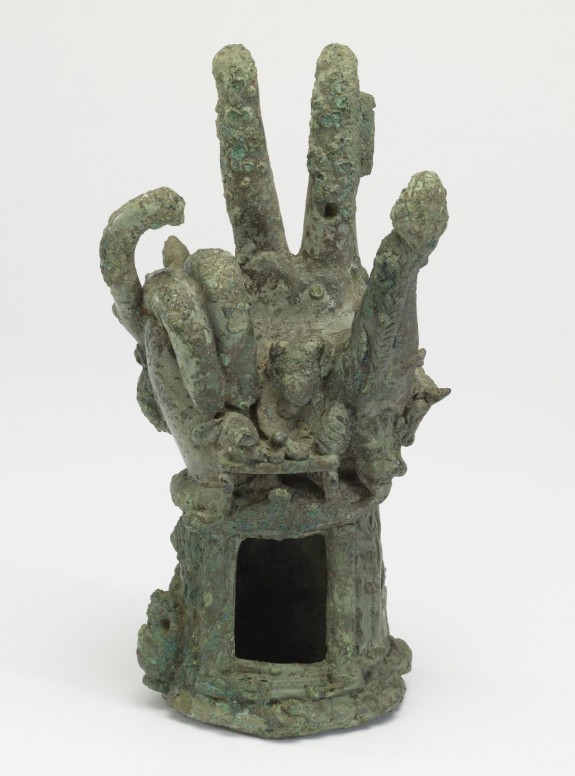
These are from the British Museum, Harvard, and the Walters Museum. The Hand of Sabazios usually holds something, an acorn or a snake or sometimes even a small figure.
Bunnies, eggs and Easter
It seems to have become a tradition that every year at this chocolatey time I talk about what Easter bunnies and Easter eggs have to do with the death and resurrection of Jesus.
The answer is, nothing at all! The word Easter comes from a Germanic pagan fertility Goddess called Eostre, if you speak Old English, or Ostara, if you speak Old High German. It just so happens that the month we call April, the people who spoke Old English called Eostre's Month.
The first mention in history of the original Easter festival comes from no less than the Venerable Bede, a brilliant monk who lived in England in the 600s AD. Bede was a major player in the hot subject of his day: how to calculate when the death and rebirth of Jesus should be celebrated. He wrote a book about it called De Ratione Temporum which means On Calculating Time.
Bede's calculation landed the Christian event in Eostre's Month (April!). Bede commented in the same book, in an almost offhand way, that Eostre's Month traditionally saw the locals hold festivals in honour of the pagan goddess Eostre.
Bunnies are particularly good at doing the fertility thing, and eggs have the obvious meaning. Bunnies and eggs therefore are the symbols of the German fertility goddess. This all got mixed up with the Christian event and since no one in their right minds turns down chocolate, I don't think they'll be separating any time soon.
I went looking for a decent translation of Bede's original comment and the best I could find was from tertullian.org, who in turn got it from a translation by Faith Wallis, Liverpool University Press 1988, pp.53-54.
Happy Eostre / Ostara / Easter !
The answer is, nothing at all! The word Easter comes from a Germanic pagan fertility Goddess called Eostre, if you speak Old English, or Ostara, if you speak Old High German. It just so happens that the month we call April, the people who spoke Old English called Eostre's Month.
The first mention in history of the original Easter festival comes from no less than the Venerable Bede, a brilliant monk who lived in England in the 600s AD. Bede was a major player in the hot subject of his day: how to calculate when the death and rebirth of Jesus should be celebrated. He wrote a book about it called De Ratione Temporum which means On Calculating Time.
Bede's calculation landed the Christian event in Eostre's Month (April!). Bede commented in the same book, in an almost offhand way, that Eostre's Month traditionally saw the locals hold festivals in honour of the pagan goddess Eostre.
Bunnies are particularly good at doing the fertility thing, and eggs have the obvious meaning. Bunnies and eggs therefore are the symbols of the German fertility goddess. This all got mixed up with the Christian event and since no one in their right minds turns down chocolate, I don't think they'll be separating any time soon.
I went looking for a decent translation of Bede's original comment and the best I could find was from tertullian.org, who in turn got it from a translation by Faith Wallis, Liverpool University Press 1988, pp.53-54.
Eosturmonath has a name which is now translated "Paschal month", and which was once called after a goddess of theirs named Eostre, in whose honour feasts were celebrated in that month. Now they designate that Paschal season by her name, calling the joys of the new rite by the time-honoured name of the old observance.
Happy Eostre / Ostara / Easter !
Pontifex Maximus
In a post as closely relevant to current affairs as you're ever likely to see on this blog, I thought I'd mention that the job title Pontifex Maximus, better known these days by the shorter form Pope, is far older than the Roman Catholic Church. The most famous pre-Christian holder of the office was a chap by the name of Julius Caesar.
It was because Caesar was Pontifex Maximus that he was able to reform the calendar. (Since in Rome the Pontiff owned the calendar, like the Eponymous Archon did in Athens).
The rule most interesting to a mystery writer though is that the original Pontifex Maximus was forbidden to see any dead body.
It was because Caesar was Pontifex Maximus that he was able to reform the calendar. (Since in Rome the Pontiff owned the calendar, like the Eponymous Archon did in Athens).
The rule most interesting to a mystery writer though is that the original Pontifex Maximus was forbidden to see any dead body.
Jesus' Marital Status
I can't resist coming back to the subject of reliability of ancient documents, given all the interest at the moment about an ancient scrap of papyrus that mentions Jesus having a better half. The story goes that Harvard has translated a genuine fragment of 4th century Coptic that says, amongst other things, "Jesus said to them, 'My wife...she will be able to be my disciple...'"
The excitement is something of a media beat up, because that scrap was first translated by a German scholar about thirty years ago. Nobody got too upset back then. In fact, he was totally ignored. I guess Harvard has a better PR department. Be that as it may, I thought it might be fun to look at this as if it were a bit of book research for one of my ancient murder mysteries...could I use this in an historically accurate novel?
First off, just because something was written a long time ago, it doesn't mean it's true! A lot of people assume that ancient writings are inherently credible.
The ancient world was as well stocked for crazies as the modern. If you were to collect random scraps of paper from our modern age, and accepted all of them as true, you would certainly come to the conclusion that people in the 21st century were regularly kidnapped by space aliens, that men never walked on the moon, and that 911 was a CIA plot. Imagine if someone in the future discovered a scientology text. How embarrassing would that be? So one possibility is we're looking at the 4th century equivalent of scientologists.
The provenance is unknown. The papyrus might be from a coffin (they often used old papers to build cheap sarcophagi), or maybe a rubbish tip. The papyrus appears to be a copy of an older text. The original could have been written any time in the previous three hundred years. How close the original dates to 30AD is rather important. (I once wrote an article about the degree to which I trust historical sources.) On the evidence, we just don't know. But the closer it is to the real event, the happier I'd be.
So the next question is, is there any cross-reference to corroborate? (I use this test all the time for book research.) The answer is no, not really. Plenty of speculation about that Magdalene girl, but nothing concrete.
How about archaeological evidence? No, zero.
Does the information look credible? Sure it does. The fact that it's written in Coptic gives it street cred. There were a lot of Bibles being written in Egypt at at that time in Coptic. We might be looking at something that got chopped in final revisions. You know how editors can be. Also, the original Bible was compiled in Koine Greek by scholars in Egypt who were probably the great great grand dads of the guys doing the Coptic versions.
The ultimate test for any historical novel is, does the idea break history? This idea doesn't, so it's fair game.
Ghosts of Ancient Greece
The Greeks were one of the very few people throughout history to not have a strong belief in ghosts. In fact I'd be willing to bet there are more people in the western world per capita today who believe in ghosts, than there were in Athens in 460BC.
I put this down to the Greek belief that the world was fundamentally explainable by rational means. That very modern viewpoint was totally at odds with their own religion, and the deeper thinkers of the time were painfully aware of the paradox. Yet nevertheless, give a Classical Greek a problem, and he would instinctively look for a rational solution. This rather suits me as a mystery writer.
The unusual converse however, is that although people didn't believe the dead visited the living, they did believe the living could visit the dead. Greek mythology is full of people just popping down to Hades for a quick chat with the shade of someone long gone. Theseus, Heracles, Odysseus, Aeneas and Orpheus all take the plunge and return to tell the tale.
The important thing to a Greek was to make sure the spirits of the dead made it into Hades, after which they weren't coming back. This was largely arranged via the funeral ritual.
Here is Nicolaos, visiting the body of his first ever investigation:
I stepped forward to the body, as was required. An urn of ashes had been placed there. I dipped my hands in, raised them high above me, and poured a handful of ash over my head, felt the soft falling touch against my face, and the harsh burnt smell in my nose. Looking down I could see the pattern of black and white specks on the floor all about me, where every visitor before had done the same thing.
I cried and lamented for the shortest time I decently could, inspecting the body all the while. Ephialtes had been dressed in a white shroud. A honey cake rested by his right hand. A strip of linen had been tied around his chin to the top of his head, to keep his mouth shut, by which I knew the coin, an obol, had already been placed in his mouth.
Ephialtes would give the coin to Charon the Ferryman, who would carry him across the Acheron, the river of woe, on his way to Hades. He would cross the river Cocytus of lamentation, and the Phlegethon of fire, before coming to the river Lethe, where he would dip in his hand and drink of the waters, and so lose all memories of his earthly life, finally coming to the Styx, the river of hate, after which he would be in Hades, and remain there for all eternity.
You'll notice I managed to get in the basic geography of Hades, as it was generally agreed. This is pure exposition, so I was probably a bit naughty, but I thought it was kind of cool to sneak it in. Nico doesn't mention it here, but the body when it lay in state awaiting burial was always placed with its feet towards the door, which was to prevent the dead man's psyche from wandering off.
The psyche was the closest thing the Greeks had to a ghost. It was possible, if burial hadn't been performed properly, for the psyche to hang around. But this was extremely rare because the Greeks had enormous respect for the dead, even of their enemies. (Which is what made Achilles' mistreatment of Hector's body so very shocking.)
A lot of people think the coin placed in the mouth was to pay to get over the river Styx. Nope. Hades had many rivers, and the first of them was the Acheron. That's the one Charon the Ferryman carries you over. The Styx was the end of the line; when you crossed it, you'd reached Hades.
The coin placed in the mouth was an obol, not a drachma. Six obols make a single drachma, which was the average daily wage in Athens. So an obol represents about 2 hours of work and is probably what a for-real ferry crossing might have cost at the time. It also meant anyone could afford to get their loved ones to their eternal home.
There was no concept in Greek religion of being judged after death. Good or bad, you ended up at the same place.
Happy Eostre or Happy Ostara or Happy Easter
I hope everyone's had a great Easter!
Easter is derived directly from a Germanic pagan fertility Goddess called Eostre, if you speak Old English, or Ostara, if you speak Old High German. Spelling is highly variable on this because, back in those days, most people couldn't.
Interestingly, Eostre is mentioned in writing in only one place, the work of the Venerable Bede, a mediaeval monk and early self-publisher. He said in De Ratione Temporum - which was a bestseller in its day - that Eostre's Month (= April = Spring) was once celebrated with feasts in honor of the Goddess. De Ratione Temporum means On Calculating Time and a lot of the book is about how to calculate when Easter is on.
It's interesting that Eostre appears nowhere in Norse lore. Her only mention is in that early Christian book by Bede.
So if you ever wondered what bunnies and eggs had to do with Jesus, now you know: nothing at all. They are both carryover fertility symbols associated with the Goddess of Spring. And a good thing too, or we wouldn't get all that chocolate.
I hope the Easter Bunny was good to you!
(This is a modified version of a post I did last Easter, but I think the origin of Easter is rather cool so I'm repeating.)
Sacred sex and temple prostitution
I was planning to write about this myself some time, but Mary Harrsch has done such a great job that you should read her excellent summary on whether sacred sex was practiced in ancient times.
Sacred sex is the idea that some temples - invariably dedicated to Aphrodite or the local equivalent - had in-house prostitutes whose service was considered part of the worship. Whether it ever actually happened is very controversial.
I have no choice but to form a definite opinion because I must describe these temples in my books! Particularly the Artemision at Ephesus which appears in the second book, and for which there's a claim of temple prostitution. (And my view is there wasn't.)
Most mention of this subject comes with the sound of ideological axes grinding in the background. Which makes Mary's article so valuable, because it's actually even handed.
The Curse of the Alcmaeonidae
It sounds like the title of a really bad horror movie, but it was a for-real curse that happened in 632BC.
There was at that time in Athens a famous Olympic victor called Cylon. Like many famous people to this day, Cylon assumed that fame in one field guaranteed success in another. He should have consulted with a career advisor, because unfortunately his chosen new life plan was to make himself the Tyrant of Athens.
In his defence, it must be said that Cylon was probably encouraged by his father-in-law, who happened to be the tyrant of a city called Megara, just up the road. Sometimes it can be really tough for a guy to impress the wife's family.
It all went horribly pear-shaped when Cylon gathered together his friends and attempted an armed takeover. He seems to have assumed the common people of Athens would flock to his leadership when they saw what was happening. But when the fighting began, the people of Athens were notable by their absence, and Cylon and his followers had to retreat to the temple of Athena atop the Acropolis. (Not the Parthenon. The Parthenon would not be built for another 200 years.)
Then Cylon managed to escape, leaving his hapless friends trapped inside the temple, to face the consequences of his ambition. By the end of the day, Cylon had set a new record for total leadership FAIL.
Now everyone had a problem. As long as the coup plotters stayed inside the temple, they were safe, because all Greek temples had sanctuary. Anyone who harmed a person under the protection of Athena was looking at some serious trouble. (Cylon's friends were neither the first nor last to rely on temple sanctuary for protection; it was perfectly normal for pursued criminals to make a beeline for the nearest altar.)
Negotiations began between the coup plotters and the archons (city officials). The archons convinced the men to come out, in return for a fair trial. I can't imagine what fair trial the plotters thought would result in them surviving, but presumably they planned to argue it was all Cylon's fault.
There are different stories about what happened next. The most dramatic says the plotters emerged, tied to a rope which they'd fastened at the other end to the cult statue of Athena within the temple, to maintain their connection with the Goddess.
Another version says the archons swore before Athena that the plotters would have sanctuary while the law took its course. Either way, everyone agrees the men were under the protection of the Goddess when they emerged to go to the place of trial, which certainly would have been the adjoining rock of the Areopagus.
Among the archons was a man called Megacles, from the genos (family) Alcmaeonidae (ALC-MAY-ON-ID-AY). When the friends of Cylon were out in the open, the archon Megacles and all the men of his family fell upon them and killed them.
No one cared about the dead plotters, but the men of the Alcmaeonidae had just broken the sacred sanctuary, and that was a big deal. A very big deal.
Megacles claimed (in the rope version) that they'd seen the rope break, meaning Athena had repudiated her protection. But that weak excuse didn't wash.
At once a curse fell upon the family - in Greek, a miasma - and not just upon the men who committed the crime, but upon every member of the family. And not just those living, but every man, woman and child to be born into the family forever after.
This crime was so bad that the Alcmaeonidae were, in fact, eternally cursed.
To expiate the sacrilege, and to avoid a furious Athena from destroying her own city, Megacles and the Alcmaeonidae were expelled from Athens.
Then they dug up the remains of dead members of the family and threw them out too.
That's the way things stayed for 40 years, until Solon the Wise allowed the family to return, because Solon was a weak-kneed, bleeding heart, soft-on-crime wimp. Or so the dissenting Athenians thought as the accursed family walked back in the gates. Nevertheless Athens failed to be destroyed by the Alcmaeonid presence, and things settled down.
Now the Alcmaeonidae were destined to become a driving force behind democracy. Note that the crime for which they'd been cursed was the ruthless slaughter of would-be tyrants.
Eighty years later, a tyrant did manage to take Athens, and the Alcmaeonidae had a very uneasy relationship with him. The family head at the time - another Megacles - married his daughter to the tyrant, which kept the peace for a while, but eventually the Alcmaeonidae were instrumental in removing this tyranny too. Supporting freedom was obviously a family tradition.
Then an Alcmaeonid called Cleisthenes introduced the democratic reforms which led to full democracy 50 years later under Ephialtes. When Ephialtes died, he was replaced by Pericles, who was...you guessed it...an Alcmaeonid on his mother's side.
But it didn't matter how successful the Alcmaeonidae became; whenever a member of the family was put in charge of anything, someone was bound to ask, "But what of the curse?" Even the Spartans raised it when they were dealing with Pericles, 200 years after the crime.
It must be pointed out that the curse on the family was eternal. Which means their descendants living today, of which there must surely be some, are in fact, cursed.
Give me some of that old time religion
How hard would it be to practice the ancient Greek religion these days?
Yes, I'm aware there are people doing their own modern versions of the ancient worship, but I'm talking about worshiping the Gods and Goddesses as it was done back in the good old days; done so well that an ancient Greek transported 2,500 years into the future would recognise his own religion.
The answer is: very tough indeed.
To start with, if you're not sacrificing animals, then you're just not doing it right.
Sorry, but that's the way it is. Animal sacrifice is central to ancient religion but anathema to virtually anyone practicing modern paganism. I certainly wouldn't condone it; it would probably be illegal in most countries; but if you want to do religion the way the Greeks did then you don't have a choice. Every important ritual and festival required a sacrifice, and an important element was that the sacrifice "agree". It's fine to have a BBQ afterwards, but you'll need some butchering skills which aren't exactly common these days.
You need an almost encyclopaedic knowledge of Homer.
The Greeks had no Bible. Their entire written experience of the Gods came from Homer, and from another ancient author called Hesiod, who amongst other things wrote Theogeny, which defined the relationships between the Gods and Goddesses.
At heart the Greeks expected the Gods to behave the way Homer wrote them. It's as if we took our Christian viewpoint from Shakespeare.
Learn a lot of hymns and odes.
Actually this is good news, because most of them are very good. There were a whole pile of standards and favourites, which when you get down to it is the same as having psalms. The difference is you need to memorize a few thousand lines, because normal people didn't have books with this stuff written in. Not to worry, you'll have plenty of time to memorize while the building work is underway.
You need a cult statue. And a temple.
The Greeks did almost everything in the open air. Except religion. For that they built very elegant, very expensive temples. Inside each temple is a cult statue. The Greeks believed -- and I mean believed -- that the God or Goddess would inhabit the cult statue from time to time. (If a statue transforming into a God seems strange, consider the premise behind the Christian mass. It's called transubstantiation.)
So you need to get together with some friends and buy some decent land. Put a Greek temple on it. The design is very well known but it's a non-standard form these days so the material and labor might be a trifle expensive.
When you've finished the temple hire the best sculptor you can afford for the cult stature. Something ten times larger than life in ivory, gold and silver would be just great, but if that's outside the budget, you may have to settle for a lifesize marble or a cast bronze.
Did I mention you have to do one of these statue/temple combos for each God?
You don't need every minor deity, but you definitely have to cover all the majors. That's Zeus, Hera, Apollo, Athena, Aphrodite, Artemis, Demeter, Dionysus, Hephaestus, Ares, Hermes and Poseidon. Don't forget any of them; not if you know what's good for you, because these guys are known for the odd spot of jealousy, they're easily offended, and they can do serious damage. Ask any Trojan.
The hermae, and mutilation thereof
This is a herm...

and this is another herm...

A herm was a bust of Hermes, who as you surely know was the Messenger of the Gods.
Athens was riddled with hermae. There was a herm at every cross-street in the city. Many houses installed a herm outside their front door. In the Agora was a platform with a hundred or more of them.
Hermes, as Messenger of the Gods, was protector of travellers. By placing his bust anywhere a traveller might pass, the superstitious Greeks were doing their best to protect anyone out on the streets.
Interestingly, Hermes was also protector of thieves, presumably because as an occupational hazard thieves often need to travel quickly at short notice.
In Athens these busts would have been set atop a short pillar, head height at most, and if you looked to the base of the pillar you would probably have seen the carving of an erect phallus pointing up at you, another symbol of good fortune.
These pictures are from the Met., Roman copies of Greek originals, and they are very good quality indeed compared to most hermae. Think of all the cross-streets and houses in Athens: there were thousands of these hermae. Top sculptors would have reserved their valuable time for more profitable work. Probably most hermae were churned out by low-end sculptors and journeymen learning their trade.
One morning in 415BC, Athens awoke to discover every herm in the city had been damaged. Someone had obviously gone about the city overnight destroying all the divine good luck symbols, and considering the many hundreds of hermae involved it could only have been a calculated act of sabotage. This incident has gone down in history as The Mutilation of the Hermae.
Athens was paralyzed with fear. This wasn't mere sacrilege; to most people the Gods were as real as a smack in the face, and a God's cult statue was a place the God could inhabit. The mutilation of the hermae was like kicking the God Hermes in the balls a hundred times over.
The Athenians expected direct and dire divine retribution at any moment. A frenzied search for the culprit began at once. In the panic it only became necessary for someone to suggest a culprit for the accused to be arrested, and more than one of these unlucky men were executed, but the panic went on. Fairly soon debtors were accusing their creditors as a novel means of debt cancellation.
Then suspicion fell upon a fascinating scapegoat: Alcibiades, the first cousin once removed of Pericles. Indeed Pericles, though dead by this date, had been legal guardian of Alcibiades as a child. Alcibiades was brilliant, daring, wealthy, handsome, clever, opportunistic, egotistical, dissolute and utterly self-serving. This was the sort of insane thing Alcibiades might do for a joke.
Now Alcibiades was guilty of any number of crimes in his life, but this probably wasn't one of them. Nevertheless the mud stuck, and even though by then he'd departed to lead an invasion of Sicily, he was recalled to stand trial.
Alcibiades wasn't a complete moron; he turned tail and ran, straight to the Spartans with whom Athens was at war. In revenge, Alcibiades advised the Spartans how best to defeat Athens, and his advice was good.
And so the bad luck of the mutilation came to pass, because the man charged with the crime contributed to the downfall of Athens.
It must be added Alcibiades changed sides again later, and Athens took him back before expelling him once more. If he were alive today, Alcibiades would be a junk bond trader, or a used car salesman, or a world leader, or possibly all three at once.
The real culprit of the Mutilation of the Hermae and the motive for it remains ones of the ancient world's greatest unsolved mysteries.
The Artemision of Ephesus
The Temple of Artemis in Ephesus, also called the Artemision, was among the Seven Wonders of the Ancient World. This is a model from the Miniature Park in Istanbul. It's probably fairly accurate, except the real thing would have been painted in bright colors. It was built entirely in marble, except for the roof. Back in Athens every temple was still wooden, including the columns, so the Artemision was an engineering marvel for its day.
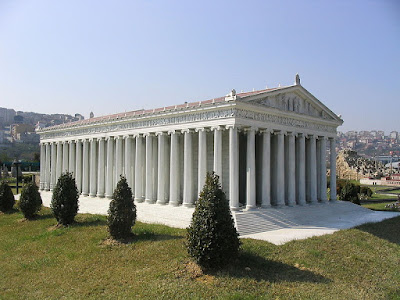
The cult statue of the Goddess was particularly interesting. I could describe her, but why bother when Nicolaos can do it for me. Nico passes through Ephesus in my second book, and he could hardly miss a tour of the famous temple. Here are Nico and Diotima inside:
Here is Artemis of Ephesus:

Diotima has her facts right (as usual), but for some slight mangles caused by the Greeks not knowing their past as well as we know it today. There was a temple on the site of the Artemision dating back at least to the bronze age, no doubt rebuilt many times. The Amazons were indeed believed to have worshipped there before the fall of Troy.
The curtain placement before the cult statue is correct, btw. Pausanias, who saw it, says: At the temple of Zeus in Olympia...the curtain is not drawn upwards to the roof as is that in the temple of Artemis at Ephesos... Alright, I'm showing off by mentioning it, but I was rather pleased with myself for spotting the detail.
The Artemision was indeed a declared sanctuary, of such importance that even the Great King of the Persians respected it. Xerxes burnt a number of Greek temples in Asia, but he not only spared the Artemision, he ordered the sanctuary observed by his own men. The belief in the sanctuary was so strong that at one point duing a siege the Ephesians tried to extend it by chaining the city to the temple. Herodotus says:
The first Greeks that King Croesus of Lydia attacked were the Ephesians. These, besieged by him, dedicated their city to Artemis; they did this by attaching a rope to the city wall from the temple of the goddess, which stood seven stades away from the ancient city which was then besieged.
The version of the temple Nico and Diotima see is about 90 years old and in fact the rich Ephesians are still working on finishing touches. A new cult statue might have been made at that date, which would have been based on the one before it. Diotima and Nico appear to be looking at the original.
The Artemision is one of the temples associated with sacred prostitution by both Pausanias and the Bible. The claim is highly contentious to this day, and for my money, it's wrong. Sacred prostitution is a subject on which I plan to write in the future because, although I think the claim is false for Ephesus, there are other places around the ancient world where it's probably true.
A more probable claim, IMHO, is that the Artemision was served by eunuch-priests or eunuch servants of some form. Why is it more probable? Because although the Greeks were not keen on eunuchy, the Asian side of the Aegean Sea was, and the province of Ionia, in which Ephesus lies, is in Asia Minor with a large non-Hellene population. The Artemision was there well before the Greeks were, so a hang over from the past is viable. Eunuch priests are also better documented than temple prostitutes. Strabo says point blank the eunuchs were there and they were called the megabyzoi.
The Artemision had a hard time staying upright. The temple Nico and Diotima see was burnt down 100 years later by a man who did it on purpose so he'd be remembered forever. The Ephesians tortured him to death and didn't write down his name. Unfortunately some fool recorded it later, but I'm not going to pass it on.
 The arson is said to have happened the same night Alexander the Great was born, but this is doubtful considering how vague the calendars were. The temple was rebuilt and then destroyed again by Goth raiders. The next version survived until it was torn apart for the last time by a Christian mob and the stones used for other buildings, including apparently the church of Saint Sophia in Istanbul. Someone has piled some of the remaining rubble one bit on top of another to create a single, makeshift, forlorn column where one of the wonders of the ancient world once stood.
I'll leave the last word for Antipater, who created the list of the Seven Wonders:

The cult statue of the Goddess was particularly interesting. I could describe her, but why bother when Nicolaos can do it for me. Nico passes through Ephesus in my second book, and he could hardly miss a tour of the famous temple. Here are Nico and Diotima inside:
We stopped at an immense red curtain, hung from the ceiling. It was drawn up, great folds of material spilling over the ends. The drawn curtain revealed the statue of the Goddess. Artemis stood high and proud, her arms outstretched like a supplicant, or a mother welcoming her children. Her chest was covered with breasts, not merely the standard two, but more than I could count at a glance, all hard and full of milk.
I admired the Goddess for some time while Diotima waited patiently beside me. I cleared my throat. “I take it we are not viewing Artemis here in her guise as the Huntress?”
“Hardly,” Diotima murmured.
In Athens, Diotima was a priestess at the temple of Artemis Agrotera, which is to say, Artemis of the Hunt. There the Goddess is depicted as a fit young maiden armed with bow, accompanied by a deer as she hunts through the forest. The temple of Artemis Agrotera lies at the spot where Artemis first hunted when she came to Athens from the island of Delos.
“The Artemis of Ephesus is a Mother Goddess, and a Goddess of Fertility,” Diotima lectured.
“You don’t say,” I muttered, counting the breasts. “Twenty-one, twenty-two...”
Diotima glared. “Keep it pious, Nicolaos. Just because the Goddess appears to these people as the Mother is no reason she can’t transform for your benefit to something more likely to put an arrow through you. She’s still the same person, you know. The Gods appear to us in many forms but they’re each a single deity within.”
I commented, “The cult statue looks a little old.” The stone and wood was stained and cracked and aged, despite their efforts to keep it pristine. The style was stiff and, well, wooden; noticeably of a period long, long ago.
“This statue of the Goddess was dedicated by the Amazons.”
“What, as in Troy?”
“Oh yes. The Amazons worshiped Artemis. They came here to the Artemision several times, the first during their war against King Theseus of Athens, and that was a generation before the war against the Trojans.”
I studied the Goddess in new appreciation. “This place is that old?”
“Older. The Artemision was built by the demigod Ephesos, who founded the city under the protection of the Goddess. Since that day, it's been the greatest ill-deed to lay a hand against anyone who claims protection of the temple. The whole civilized world knows of the sanctuary of the Artemision.”
“I didn’t.”
“I said ‘civilized’.”
Here is Artemis of Ephesus:

The curtain placement before the cult statue is correct, btw. Pausanias, who saw it, says: At the temple of Zeus in Olympia...the curtain is not drawn upwards to the roof as is that in the temple of Artemis at Ephesos... Alright, I'm showing off by mentioning it, but I was rather pleased with myself for spotting the detail.
The Artemision was indeed a declared sanctuary, of such importance that even the Great King of the Persians respected it. Xerxes burnt a number of Greek temples in Asia, but he not only spared the Artemision, he ordered the sanctuary observed by his own men. The belief in the sanctuary was so strong that at one point duing a siege the Ephesians tried to extend it by chaining the city to the temple. Herodotus says:
The first Greeks that King Croesus of Lydia attacked were the Ephesians. These, besieged by him, dedicated their city to Artemis; they did this by attaching a rope to the city wall from the temple of the goddess, which stood seven stades away from the ancient city which was then besieged.
The version of the temple Nico and Diotima see is about 90 years old and in fact the rich Ephesians are still working on finishing touches. A new cult statue might have been made at that date, which would have been based on the one before it. Diotima and Nico appear to be looking at the original.
The Artemision is one of the temples associated with sacred prostitution by both Pausanias and the Bible. The claim is highly contentious to this day, and for my money, it's wrong. Sacred prostitution is a subject on which I plan to write in the future because, although I think the claim is false for Ephesus, there are other places around the ancient world where it's probably true.
A more probable claim, IMHO, is that the Artemision was served by eunuch-priests or eunuch servants of some form. Why is it more probable? Because although the Greeks were not keen on eunuchy, the Asian side of the Aegean Sea was, and the province of Ionia, in which Ephesus lies, is in Asia Minor with a large non-Hellene population. The Artemision was there well before the Greeks were, so a hang over from the past is viable. Eunuch priests are also better documented than temple prostitutes. Strabo says point blank the eunuchs were there and they were called the megabyzoi.
The Artemision had a hard time staying upright. The temple Nico and Diotima see was burnt down 100 years later by a man who did it on purpose so he'd be remembered forever. The Ephesians tortured him to death and didn't write down his name. Unfortunately some fool recorded it later, but I'm not going to pass it on.
 The arson is said to have happened the same night Alexander the Great was born, but this is doubtful considering how vague the calendars were. The temple was rebuilt and then destroyed again by Goth raiders. The next version survived until it was torn apart for the last time by a Christian mob and the stones used for other buildings, including apparently the church of Saint Sophia in Istanbul. Someone has piled some of the remaining rubble one bit on top of another to create a single, makeshift, forlorn column where one of the wonders of the ancient world once stood.
I'll leave the last word for Antipater, who created the list of the Seven Wonders:
I have set eyes on the wall of lofty Babylon on which is a road for chariots, and the statue of Zeus by the Alpheus, and the hanging gardens, and the colossus of the Sun, and the huge labour of the high pyramids, and the vast tomb of Mausolus; but when I saw the house of Artemis that mounted to the clouds, those other marvels lost their brilliancy, and I said, 'Lo, apart from Olympus, the Sun never looked on aught so grand.
Meanwhile, over in the Tulgey Wood
Mimzy has written a very good post about Norse Mythology.
I am, by the way, descended from Odin, King of the Norse Gods, but I'll save my proof of that for another day.
I am, by the way, descended from Odin, King of the Norse Gods, but I'll save my proof of that for another day.
Sacrificing animals
I suppose most of you have attended a church service and then gone to a community barbeque. Keep that in mind as you read this.
The Greeks, and virtually all the ancient peoples, had a few habits with a high yuck factor for moderns. One of the more yucky bits was sacrificing animals in religious rites, which they did frequently.
I suspect some people have an image of a crazed Greek plunging his knife into a squealing, struggling animal as the blood spurts everywhere and the crowd chants chthonic prayers.
Nothing could be further from the truth. The whole thing was very orderly.
In the Greek mind, it was important the animal "agree" to be a sacrifice. An unwilling sacrifice, one which struggled, was considered an ill omen. If any Greek priest had conducted a sacrifice like I just described, it would have been like the vicar turning up drunk for the sermon.
For days before, the selected sacrifice was treated kindly. It was given good food and made as comfortable as possible. Most sacrifices were sheep and pigs. Goats were a common standby. Oxen were luxury items for big events.
The sacrifice would be led from its farm to the temple. The sacrificial altar was put outside for obvious reasons, probably by the front steps. During whatever was the ritual for the particular God or Goddess, there came a point where the priest would take out a knife and quickly slit the animal's throat. This is a perfectly standard way to kill any farm animal for butchering, and in an agrarian society, virtually everyone would have the skill.
The blood was caught in a bowl and I presume was given to the God or Goddess.
A priest would then open the body and check the liver and entrails to see if the God or Goddess was pleased with the sacrifice. I expect the answer was always yes, unless there was something pathologically wrong.
If a Classical Greek saw one of our modern abattoirs, he would be shocked at the impiety and disgusted at the process. Not because of how many animals are killed there, but for the lack of respect shown the animals. The average animal sacrificed in ancient Greece probably died happier and in greater comfort than the steak you eat tonight.
Speaking of steak...
After the sacrifice the victim was butchered by someone who knew what he was doing. The long bones and probably some offal were burned in a brazier for the God or Goddess to consume. The rest of the meat was barbequed on the spot and everyone stayed for a community picnic!
If you were the child of a poor laborer, quite possibly the only meat you would see in your life was that given to you at the public sacrifices. The sacrifices were donated by rich men, and therefore were a roundabout way of donating quality meals to poor families. Animal sacrifice at the temples was, weird as it may sound, a community service.
This might seem a roundabout way of delivering the picnic food, but ancient Greece had a distinct lack of refrigerators. Without them, meat could not keep for long, even if it was preserved in sea salt. The only way to ensure the meat at a BBQ was fresh and healthy to eat was for it to arrive still breathing.
So the whole thing was nowhere near as yucky as you might think. Something to ponder the next time you go to church and then a barbeque.
Subscribe to:
Posts (Atom)