I finally fixed it. Ages ago, I complained that PDF documents on my computer were going fuzzy in weird ways. This is the example I put up:
This is my list of for-real ancient Greek people, from which I pick character names. What happened was bizarre. I could open the list, and everything would be fine. Then right before my eyes, the list would slowly but surely turn unreadably fuzzy. I always thought it was because Adobe was rendering non-English, but that turns out not to be the case. It happens with mathematics textbooks too.
A lot of googling put the blame on the morphological filter in AMD's video driver, but that never really fixed it. I just lived with the fuzziness. But when it reached the point of interfering with my children's homework I put in a concerted effort, and discovered this in Adobe's config:
Turn off 2D graphics acceleration in Adobe. That fixes it. The reason people think it was the AMD driver is that, when you cripple the driver enough, Adobe can no longer do harm.
If this problem hits you, Go to Edit --> Preferences in Adobe Reader. Select Page Display. Disable as per the image. Done.
The most unusual duel in history
The most unusual duel in history took place in Paris, in 1808, when two gentlemen, Monsieur de Grandpre and Monsieur le Pique, discovered by accident that they were enjoying the favours of the same lady, a certain Mademoiselle Tirevit. The gentlemen concluded, via their seconds, that the universe wasn't big enough for the both of them. There was nothing for it but that they must fight a duel.
Here they diverged from the standard script. It was agreed by all that the duel be fought from identical hot air balloons, and that the weapon of choice should be a blunderbuss.
One would have thought that in the ensuing month, during which identical balloons were constructed, that cooler heads might have prevailed, but apparently there were none. The balloons were duly delivered and the principals, their seconds and "an immense concourse of spectators" met in le Jardin des Tuileries on the 22nd of June. If you've ever visited Paris, you've probably walked across where this happened.
I can understand M. de Grandpre and M. le Pique getting into their balloon baskets, but I must question the mental stability of their seconds, who clambered in after their principals, in order to share their fate. The ropes were cut simultaneously and the two balloons rose into the air, to an estimated height of half a mile. The balloons at this stage were separated by about 80 yards.
M. le Pique had the honour of firing first. He brought up his blunderbuss, aimed carefully at the balloon above M. de Grandpre's head, and fired.
He missed completely.
M. le Pique's second cannot have been pleased at this turn of events. But there was no backing out now.
De Grandpre raised his blunderbuss. He fired, grievously wounding le Pique's balloon, which plummeted to the earth. Le Pique and his second were killed on impact. ("Dashed to pieces" in the original account.)
Honour satisfied, de Grandpre continued his journey until he landed some seven leagues distant. History does not record the outcome of the relationship between de Grandpre and Mademoiselle.
If you think I'm making this up, it's all recorded in The Book Of Days, by Robert Chalmers, published 1863, page 809 of volume 1.
Death on the Nile
We have quite a few Agatha Christie movies on DVD, the ones in which Peter Ustinov plays Hercule Poirot. Of these, I think probably the best is Death On The Nile. I'm talking about the movie adaptions here, not the original books. I presume I'm safe mentioning spoilers on a story that was published 75 years ago...if not, avert your eyes now.
![]() |
| Would you go on a cruise with these people? |
I tend to watch these films with the critical eye of a mystery writer. They're traditional mysteries, of course, and that's quite a different thing to a modern cozy. My own stories have more than a little in common with Poirot's traditional methods, because Nico, like Poirot, has no CSI to spoil the pure logic of the puzzle.
Yet in Death on the Nile, I was deeply struck by how, in the traditional denouement during which Poirot reveals all, that at the last moment, he tells Doyle that gunshot residue can be lifted from his hands using hot wax. This is indeed a test that works. The interesting thing is that this is early CSI, and it's in an Agatha Christie. Poirot does so because the perps have correctly pointed out that he doesn't have any evidence that would fly in court. The test is what provokes the inevitable confession.
If a CSI team had been available, this story would have been over within 5 minutes of the murder.
Death On The Nile would be absolutely unwriteable in the modern world. And that's a pity, because it's brilliant fun. I have a theory that's why so many recent mysteries have retreated into past times.
The Ionia Sanction at the Historical Novel Society
The Historical Novel Society reviewed The Ionia Sanction months ago, and I utterly failed to report it here. I'm correcting that grievous fault now. Here's what they had to say:
Athens, 5th century B.C.: Nicolaos is an investigator for hire, which is not so strange considering this is the city that invented the professional philosopher. Fresh off his last case in The Pericles Commission, Nico (if I may be familiar) has another politically charged murder to solve. This time the investigation takes him to Ephesus, where he uncovers a Persian plot to conquer Athens.
The action is solidly paced and engaging throughout, while Nico’s noir-ish patter makes the history highly accessible. And there is a lot of history; every major figure gets a mention, including an irritating little brat named Socrates who happens to be Nico’s kid brother.
Corby weaves in most of these historical nuggets skillfully, and a few that at first appear to be one-off mentions end up being quite relevant to the plot. There are also some very amusing, if slightly anachronistic, jabs at modern times when Nico struggles with concepts such as trousers (a Persian innovation), and mercantilism (“You mean I could come here with a bit of money…buy something I didn’t make myself… and I’d make a profit?”) But Corby succeeds best when he shows us the subtle little nuances of the era. Moments such as Nico’s impromptu – and very touching – sacrifice to Artemis show us that he’s a lot more than Sam Spade in a chitoniskos. He’s a man of a different and very intriguing era, and he’s worth reading.
Happy Easter!
Every year I write a post about where Easter comes from, and why there are bunnies and eggs for what's supposed to be the resurrection of Jesus. Rather than repeat it again, I'll mention that the original Eostre was an ancient German fertility goddess.
If you'd like to know more, including the one and only mention of Easter in mediaeval sources: here's what I wrote about Easter and Eostre.
May the furry servants of the Goddess bring you something made of chocolate!
If you'd like to know more, including the one and only mention of Easter in mediaeval sources: here's what I wrote about Easter and Eostre.
May the furry servants of the Goddess bring you something made of chocolate!
Europe's oldest known stringed instrument
The bridge of an ancient instrument has been discovered in Scotland, and it's dated to 2,300+ years ago. That's getting very close to the period I write.
The bridge is almost certainly from a lyre. At the very least, it gives us the separation of the strings. Ancient instruments are so rare that any little piece adds to our knowledge.
Here's a video about it, in which someone plays a reconstruction:
It's not clear to me that they've got the tuning right, though it was probably Pythagorean, and certainly the style of music is unknowable. But even so, this is fascinating stuff.
Windows 7 Classic Shell, and Everything Search
So what I actually hopped on to write about wasn't level 80 clerics. It was to talk about two third party apps that I find invaluable for Windows 7.
After the Vista disaster, the people who invented the ribbon interface in Office were promoted to control all of Windows. They carried across the same interface philosophy. Since I hate that ribbon, and since one of their brilliant ideas is to remove all classic menu reversion options, I stuck with XP.
Luckily for me a lot of people felt the same way, and someone did something about it. Over at sourceforge, there's a thing called the Classic Shell. This wonderful app replaces the hideous Windows 7 mega-blocky-dropdown-mess with a clean, pure, classic Windows menu.
It works brilliantly. You get the Windows 7 technical advances plus the cleanest Windows interface ever.
The next app is a better file search. In these googly days you'd think it wouldn't be possible -- or survivable -- to write a bad quality search system, but Microsoft managed it. Again. The file search in Win 7 soaks up unbelievable amounts of CPU in return for a file search that's worse then XP's. The answer is to turn it off completely and instead install the Everything search engine. It runs like the wind and uses almost no resources. The search syntax is a bit odd for anyone used to regular expressions, but once you've got it, it's very intuitive.
Cleric Level 80
This is an oldie but a goodie. Anyone who's ever played D&D, WoW, or any other fantasy role playing game will instantly relate to it.
I wonder if the fellow in the picture knows he's become the standard for super-clerics?
Literary agents on the verge of a nervous breakdown
My dear agent Janet Reid has been running a contest on her site that attracted 416 manuscript entries. Based on Janet's amusing but increasingly distraught posts on the subject, it seems some people who submitted manuscripts are unclear on the standard format. There's plenty of information around the net about ms formats, but to make it simple I thought I'd put my own ms template online for anyone to copy if they want.
This is the document format I've used to write four novels. No one's ever complained to me about it. In fact, I have a reputation amongst my editors for delivering clean manuscripts, of which the formatting is a small part, so you're probably safe to use this. This is precisely the file as I submitted it for The Pericles Commission, minus the final 350 pages. I left in some opening paragraphs so you can see the paragraph style format.
This link will open a read-only copy in another browser window:
Gary's standard ms format
A few comments:
To use, download the document and change the words. What could be simpler? Don't fiddle with the formatting. When you stare at hundreds of pages every day, the last thing you want is for someone to get creative with formatting.
A manuscript is a tool for writers, like a hammer is a tool for carpenters. When you pick up a hammer, you'd like the hammerhead and the handle to be in the same place, every time, no matter what the quality of the hammer may be. The same logic applies to manuscripts.
It would probably be a good idea to change my name for yours, unless you'd like me to receive your royalty cheques. The name in the top left is your real name; the name under the title is what you want to have appear on the cover.
Don't try to make your ms look like a book. The publisher has people who'll do that for you.
Word count in the top right of the first page need only be to the nearest thousand. It's only to get a feel for page count. The editor really doesn't care if there are precisely 97,354.64 words in your document. By the time you've finished with the edits, that number will have changed by a few thousand words anyway.
Probably the most important things are the double spacing and the very wide margins. Since publishing is still firmly embedded in the Stone Age, the editor will print your ms, on real paper, and the copyeditor will scribble all over it, probably in green pencil. Those margins and the space between the lines are where the copyeditor will save your life by fixing the errors. It's normal for Copyeditor to rewrite entire sentences in the double-space gaps. If the editor is your doctor, the copy editor is your head nurse. Don't make it hard for the nurse to look after you.
New paragraphs begin with a significant indent. Unless you want the acquiring editor to get a headache while reading your submission.
Start new chapters half a page down. The copyeditor will use the top half to write printer instructions in red pencil.
Times New Roman is the One True Font. I'm sure no one would ding you for using Georgia, but since every professional in publishing is happy to use Times New Roman, and every writing system supports it, why would you use anything else?
Don't forget to change the top left of the header for your surname and title. This is essential so that, when the editor prints your ms and three others, and then drops all four in the elevator, they have a fighting chance of reassembling the right pages in the right manuscripts. It would be unfortunate if the romantic comedy, the techno-thriller and the zombie horror got mixed up.
You'll notice I created a custom style called Story Paragraph. I honestly couldn't tell you what's in it exactly because I created it five years ago and haven't changed it since. Just apply that style to every paragraph, or use the copy format button, which is what I normally do.
Greek and Roman arches
The Greeks had no concept of an arch as we know it. The Greek temple design is incredibly elegant, and one of the most copied building designs to this day, but it amounts to piling one thing directly on top of another.
They did have an arc they could build, of a type called a corbel arch. Here's an example:
This is the famous Lion Gate at Mycenae. I took this picture myself, many years ago. The stones above the lintel have been placed to overlap a bit, one above another, so that you get the illusion of an arch in negative. The stones would stay there even if the relief of two lions didn't fill the gap. By classical times, even the corbel arch had pretty much disappeared from Greek designs.
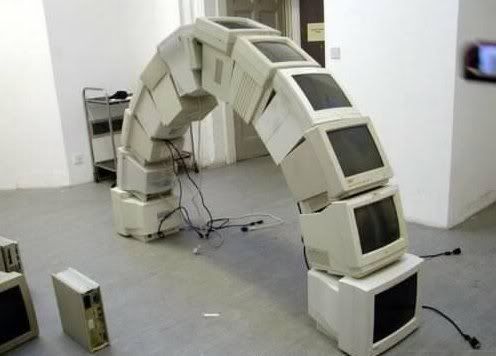
It remained to the Romans to come up with what we call the Roman Arch. I've rarely seen a better example of a Roman arch than this fine example:
As you can see, the whole thing would collapse in an instant if gravity wasn't pulling down on every block. Or in this case, on every computer monitor. It relies on shaping every block exactly for its position. The topmost block (monitor) is hugely important and is called the keystone. It's really very clever. The downside is nothing can stay up until everything's in place. So they'd build wooden supports beneath and then knock them away after the keystone was in.
The one thing both Greek and Roman architecture have in common is they both use gravity as glue.
Subscribe to:
Posts (Atom)